
Why Obstacle Courses Need More Room Than a Standard Bounce House
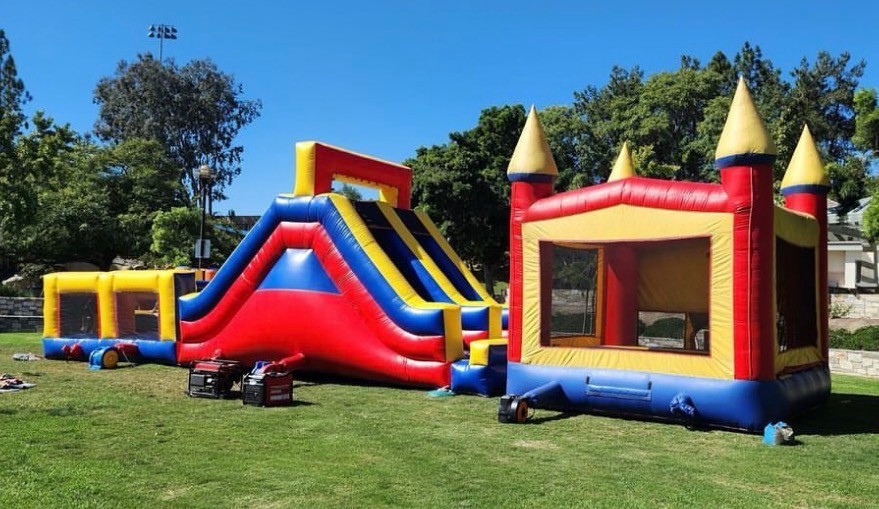
If you've ever watched a group of kids tear through an inflatable obstacle course, you already know the appeal. There's something about crawling through tunnels, scaling climbing walls, and racing down a slide at the finish line that turns an ordinary backyard birthday into a full-on event. But before you book one for your Orange County party, there's a practical question worth answering first: does your yard actually have enough room?
Obstacle courses are a different category of inflatable than a classic bounce house, and the space requirements reflect that. A standard bounce house might measure 13 by 13 feet, which fits comfortably in most OC backyards with room to spare. An obstacle course, by contrast, is designed to be experienced from one end to the other. That linear layout means the unit itself can run anywhere from 30 to 60 feet long, sometimes longer, depending on the model. Add the required safety buffer on all sides (typically 3 feet of clearance around the perimeter), and you're looking at a footprint that can easily reach 40 to 70 feet in usable length.
That distinction matters because many Orange County neighborhoods, particularly in areas like Anaheim Hills, Yorba Linda, and Mission Viejo, feature backyard layouts that are wider than they are deep, or that taper toward a fence line. A yard that looks spacious when you're standing in it can feel much smaller once you account for patio furniture, a pool, a built-in BBQ island, or a slope. Understanding the real footprint of an obstacle course before you book saves you from a stressful morning when the delivery crew arrives.
It also helps to know that obstacle courses require a continuous, relatively flat surface. Unlike a bounce house, which can sometimes be positioned on a gentle grade with proper anchoring, an obstacle course needs consistent ground contact along its full length to stay stable and safe during use. If your yard has a noticeable slope or a transition between grass and concrete partway through the run, that's worth flagging early. Our guide on water slide rental setup on sloped CA backyards covers slope considerations in more detail, and many of the same principles apply to obstacle course placement.
How to Measure Your OC Backyard for an Obstacle Course
Measuring your yard correctly is the single most useful thing you can do before reaching out to book. It takes about ten minutes and eliminates most of the guesswork on both sides. Here's how to approach it practically.
Start by identifying the longest unobstructed straight run in your yard. This is usually from the back fence to the edge of your patio or house, but in some OC homes it runs side to side along the property line. Use a tape measure or a measuring wheel if you have one, and note the length in feet. Then measure the width of that same zone. You want both dimensions because obstacle courses vary in width as well, typically ranging from 10 to 16 feet wide depending on the model.
Next, walk the zone and note any fixed obstacles. A built-in spa, a raised planter bed, a trampoline, or a large shade structure all reduce your usable footprint. Also check for overhead clearance. Some obstacle courses reach 12 to 15 feet at their tallest point, so low-hanging tree branches or patio cover extensions can create a problem even if the ground dimensions look fine.
Finally, note the surface type. Grass is the preferred setup surface because it allows for stake anchoring, which is the most secure method. Concrete and pavers can work with sandbag anchoring, but the delivery crew needs to know in advance. If you have artificial turf, that's worth mentioning too. Our guide on bounce house setup on artificial turf explains what the crew looks for when anchoring on synthetic surfaces.
Once you have your measurements, compare them against the unit dimensions listed in the Jump High Rentals catalog. If you're not sure how to interpret what you're seeing, the team is happy to talk through your specific yard before you commit to anything.
Obstacle Course Sizes and Which Fits Your Guest Count
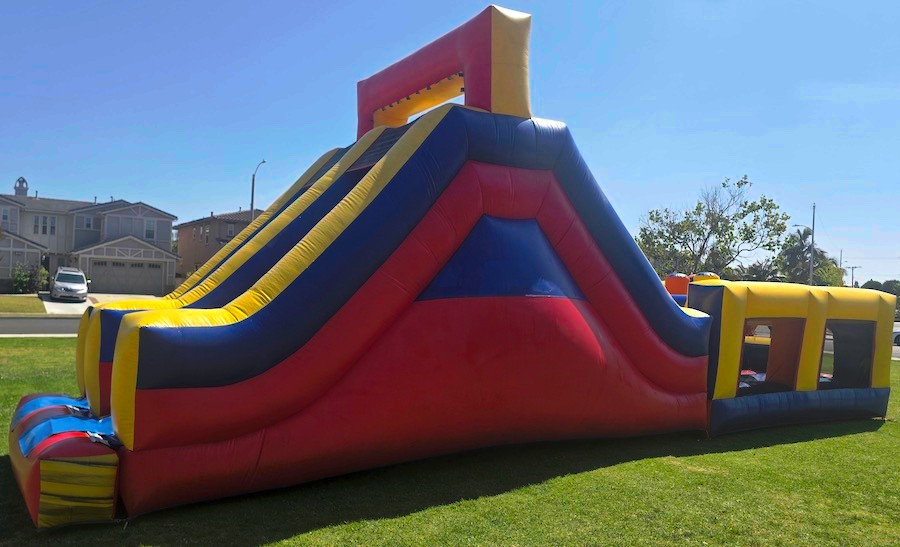
Obstacle course inflatables generally fall into a few size categories, and matching the right size to your guest count makes a real difference in how smoothly the party runs.
Shorter obstacle courses, in the 30 to 35 foot range, work well for parties with 15 to 25 kids. At that length, the course offers enough variety to keep kids engaged without requiring a massive yard. These units typically include a few climbing elements, a tunnel section, and a slide exit. Wait times stay manageable because kids cycle through relatively quickly, usually in 60 to 90 seconds per run.
Mid-size courses, running 40 to 50 feet, are a strong fit for parties in the 25 to 40 kid range. They add more challenge elements and tend to hold older kids' interest longer, which is useful if your guest list skews toward the 8 to 12 age range. If you're planning a graduation party or a school-adjacent event, this size range is often the right call. Our guide on obstacle course rentals for teen birthdays in OC goes deeper on matching unit complexity to older age groups.
Larger courses, 55 feet and beyond, are typically reserved for community events, school field days, church carnivals, and HOA gatherings where you're expecting 50 or more kids rotating through over several hours. These units need substantial yard space and often benefit from a dedicated adult supervisor stationed at the entrance to manage flow. If you're planning something at that scale, our inflatable rental checklist for OC parties with 50 guests is a useful companion resource.
One thing worth keeping in mind: guest count and yard space are both constraints, and the more limiting one wins. If your yard can fit a 45-foot course but you only have 12 kids coming, a shorter unit will actually deliver a better experience because kids won't be standing in a long queue. Conversely, if you have the space for a 55-foot course but only 20 kids, you'll still get great value from a mid-size unit at a lower rental cost.
Access, Gates, and Delivery Logistics in OC Neighborhoods
One of the most overlooked parts of obstacle course planning is getting the inflatable from the truck to your backyard. Obstacle courses arrive rolled and folded, but the bags and equipment are large and heavy. The delivery crew needs a clear path from the street to your setup zone, and in many OC neighborhoods that path runs through a side gate.
Standard side gates in Orange County homes are typically 36 to 48 inches wide. Most rolled inflatables can pass through a 36-inch opening, but it's tight, and anything narrower than 32 inches creates a real problem. Before your delivery date, measure your side gate opening at its narrowest point (including any latch hardware that protrudes inward) and share that number when you book. If your gate is borderline, the crew can sometimes angle the equipment through, but they need to know ahead of time.
Also consider the path itself. A 60-foot obstacle course doesn't arrive as one piece, but the blower, anchoring equipment, and rolled unit still need to travel from the curb to the backyard. If your side yard is narrow, has a sharp turn, or passes under a low overhang, mention it. The more detail you provide upfront, the smoother the setup goes.
Parking access matters too, especially in denser OC neighborhoods like Garden Grove, Westminster, or parts of Anaheim where street parking is limited. The delivery truck needs to be reasonably close to your property during setup and pickup. If your street has permit parking restrictions or a homeowners association with delivery rules, it's worth checking those in advance. Our guide on HOA block party bounce house rentals in OC covers some of the common HOA considerations that apply to inflatable deliveries more broadly.
Setup typically takes 20 to 45 minutes for an obstacle course, depending on size and site conditions. Plan for the crew to arrive 60 to 90 minutes before your party start time so there's a comfortable buffer for any minor adjustments. You can find more detail on what to expect from arrival through pickup in our delivery day guide for OC inflatable rentals.
Frequently Asked Questions About Obstacle Course Rentals
How much flat space do I really need for an obstacle course in my backyard?
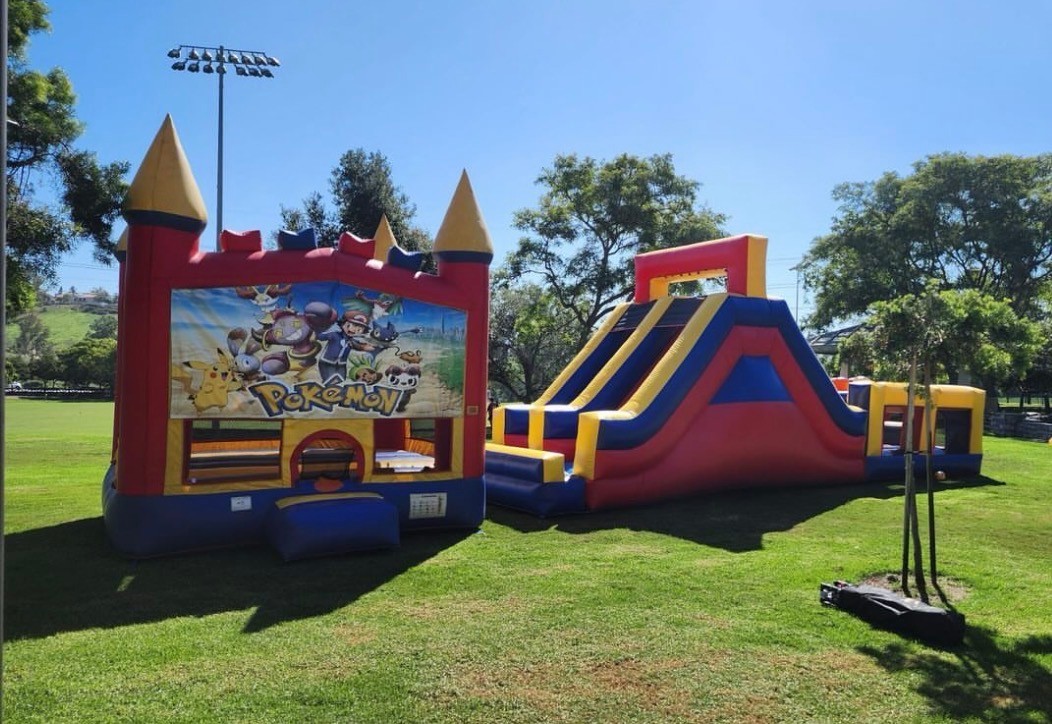
Plan for the unit's listed dimensions plus at least 3 feet of clearance on all sides. For a 40-foot course that's 12 feet wide, you'd want a usable zone of roughly 46 by 18 feet at minimum. More clearance is always better, especially at the slide exit where kids need room to land and move away from the unit.
Can an obstacle course be set up on concrete or pavers?
Yes, with sandbag anchoring instead of ground stakes. The surface needs to be level and free of sharp edges or debris. Let the team know your surface type when you book so they arrive with the right anchoring equipment.
What age range works best for an obstacle course rental?
Most obstacle courses are designed for kids ages 5 and up. Younger children can sometimes use shorter, simpler units with close adult supervision, but the climbing and tunnel elements in longer courses are better suited to kids who are confident on their feet. Our bounce house age guide for Orange County parents has more on matching inflatables to developmental stages.
Do I need a generator, or will a standard outlet work?
Most obstacle course blowers run on standard 110V household current and draw between 10 and 15 amps. A dedicated outdoor outlet within 50 to 100 feet of the setup zone is usually sufficient. Avoid running the blower on the same circuit as other high-draw appliances. Our power and extension cord guide for OC inflatables walks through the specifics.
How far in advance should I book?
Weekend dates in spring and summer fill up quickly across Orange County. Booking two to four weeks out is a reasonable baseline, but popular Saturdays in May and June can book out earlier than that. Our guide on how far ahead to book inflatable rentals in OC gives a more detailed seasonal breakdown.
Not sure whether your specific yard dimensions work for the obstacle course you have in mind? The Jump High Rentals team is happy to help you figure it out before you commit. You can browse available units in the rentals catalog or reach out directly through the contact page with your measurements and we'll point you toward the right fit.