
Inflatable Obstacle Course vs. Bounce House for School Events
Booking an inflatable for a school carnival, field day, or community event sounds straightforward until you realize the choice between a bounce house and an obstacle course can make or break the day. Pick the wrong unit and you end up with a long, restless line, a crowd that loses interest fast, or an inflatable that simply does not fit the space you have. For CA school and community event planners, the good news is that the decision comes down to a few practical factors: age range, headcount, available space, and how your event is structured.
This guide walks through each of those factors so you can book with confidence the first time.
How a Bounce House and an Obstacle Course Actually Differ
At first glance, both options are large inflatables that kids love. But they serve different purposes, and understanding that difference is the starting point for every good booking decision.
A bounce house is an enclosed inflatable chamber designed for jumping and free play. Kids enter, bounce around together, and exit when their turn is up. The activity is simple, the supervision is straightforward, and the footprint is relatively compact. That simplicity is genuinely useful in the right context.
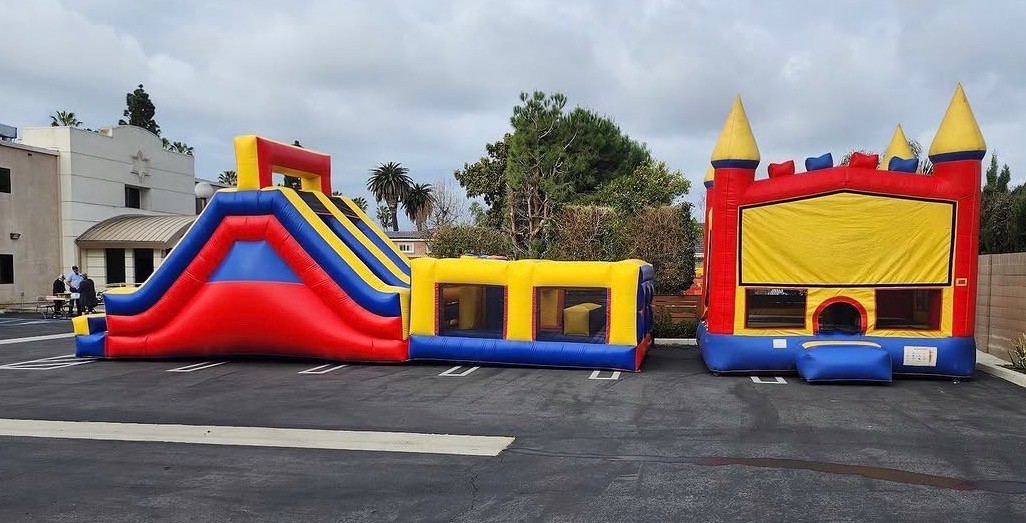
An inflatable obstacle course is built for movement from start to finish. A typical unit includes crawl tunnels, climbing walls, pop-up obstacles, and a slide at the exit. Kids enter one at a time or in small groups, work through the course, and exit at the other end. The activity is more structured, more physically demanding, and more engaging for kids who want a challenge.
The practical difference shows up in two ways. First, throughput: an obstacle course moves participants through in a defined sequence, which keeps lines flowing and gives more kids a turn over the course of an event. Second, engagement: the variety of physical challenges in an obstacle course holds attention longer, especially for older students who would quickly lose interest in a standard bounce house.
Neither unit is universally better. The right choice depends on who is using it and how.
Which Works Better for Younger vs. Older Students
Age range is the single most reliable guide for this decision, and it is the first question any good rental company will ask you.
For younger elementary students, typically kindergarten through second grade, a bounce house is usually the stronger fit. The activity is easy to understand, requires no instruction, and does not demand a high level of coordination or physical confidence. Younger kids genuinely love bouncing, and the enclosed design makes supervision simpler for teachers and parent volunteers.
For older elementary and middle school students, an obstacle course tends to win. Kids in third grade and up often find a standard bounce house boring within a few minutes. The competitive element of an obstacle course, racing a friend, beating a personal time, making it through without stopping, keeps them engaged and coming back for another turn. The physical challenge scales naturally with age, which means the same unit can serve a wide range of older kids without anyone feeling like the activity is too easy.
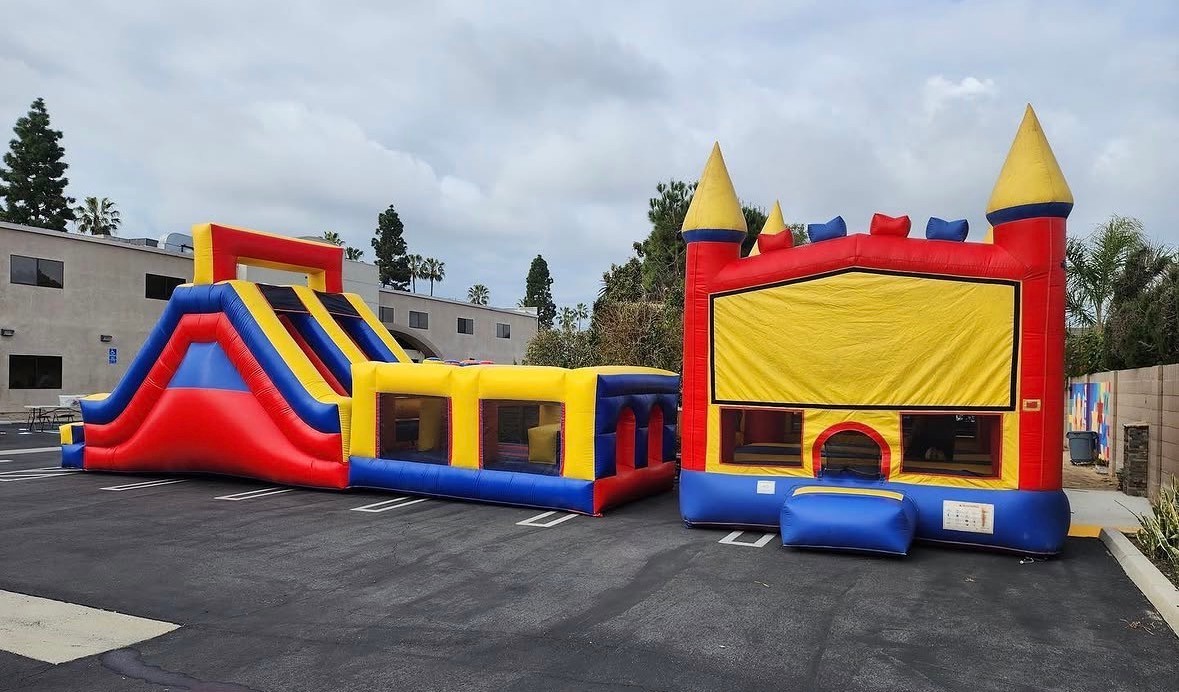
For mixed-grade events, which are common at school carnivals and field days, the obstacle course is usually the better default. It holds the attention of older students while still being accessible to younger ones, especially if you choose a unit with a moderate difficulty level rather than an extreme competition-style course. If your event includes a large number of kindergarteners or first graders, adding a smaller bounce house alongside the obstacle course gives younger kids an option that fits their age and energy level.
Crowd Size and Space: What Each Inflatable Needs
Space and crowd size are where a lot of planners run into trouble, especially when booking for the first time.
A standard bounce house has a smaller footprint than most obstacle courses. A typical residential or school-sized bounce house might occupy a 15-by-15-foot area, though commercial units used for larger events are often bigger. The compact size makes a bounce house a practical choice when your setup area is limited, such as a classroom courtyard, a small blacktop section, or a side yard at a church campus.
An obstacle course needs more room, and the space requirement goes beyond the unit itself. You need clear entry and exit zones, enough room for a line to form without crowding the participants already on the course, and safe buffer space on all sides. A mid-size obstacle course might need a 40-by-12-foot area at minimum, and longer competition-style courses need considerably more. Before you book, measure your available space carefully and share those dimensions with your rental company so they can match you to a unit that fits.
Crowd size affects the decision differently than you might expect. A bounce house can feel crowded quickly because all participants share the same enclosed space. For a large school event with hundreds of students rotating through stations, a bounce house can become a bottleneck. An obstacle course handles high throughput more naturally because participants move through in sequence rather than piling into a shared space. If your event has a large headcount and a tight schedule, an obstacle course will generally serve more kids per hour.
Matching the Inflatable to Your Event Format
The structure of your event matters as much as the age range and crowd size. Different event formats call for different inflatables.
For a field day with rotating stations, an obstacle course is almost always the better fit. It works naturally as a timed station, gives every participant a defined experience, and keeps energy high throughout the rotation. Teachers and volunteers can manage the line at the entry point while students move through independently.
For a school carnival with open free-play time, either option can work depending on your grade levels. A bounce house fits well in a carnival setting where younger kids are drifting between activities and parents are nearby. An obstacle course fits better when older students are the primary audience and you want a high-energy anchor attraction that draws a crowd.
For a classroom reward day or a smaller campus event with one grade level, a bounce house is often the simpler and more cost-effective choice. The activity requires minimal instruction, setup is quick, and supervision is manageable with a small number of adults.
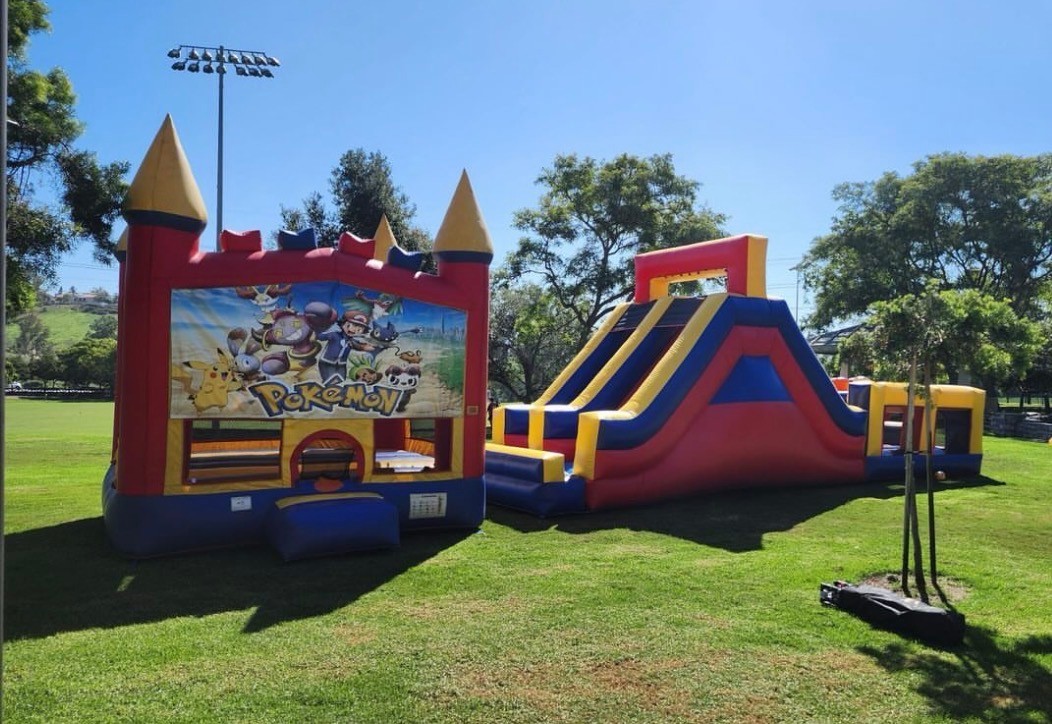
For church events, HOA gatherings, and community carnivals that serve a wide age range, consider whether one larger obstacle course or a combination of units makes more sense. A single obstacle course can serve as the main attraction while a smaller bounce house handles the youngest guests. Jump High Rentals can help you think through the right combination based on your headcount and layout.
How to Book the Right Unit for Your CA School Event
Once you have a clear picture of your age range, crowd size, available space, and event format, booking becomes much simpler. Here is what to have ready before you reach out to a rental company.
- Your event date and approximate start and end times, including when you need the inflatable set up and when pickup needs to happen
- The age range of participants, broken down by grade level if possible
- Your expected headcount and how many students will be rotating through the inflatable over the course of the event
- The dimensions of your setup area, including any access restrictions such as gates, stairs, or surface type
- Whether the site has access to standard electrical power or whether you need a generator
Lead times matter, especially for spring field days and end-of-year carnivals, which are among the busiest booking windows for CA school events. Booking several weeks in advance gives you the best selection and ensures the unit you need is available on your date.
Jump High Rentals serves schools, churches, HOAs, and community event planners across Orange County with delivery, setup, and pickup included. If you are not sure whether an obstacle course or a bounce house is the right fit for your event, reach out with your grade level, headcount, and setup space and the team can walk you through the options that make the most sense for your specific situation.