
If your backyard birthday party is coming together but your nearest outdoor outlet is on the wrong side of the house, you are not alone. Plenty of Orange County families run into the same situation every summer. The good news is that a generator can solve the problem cleanly when it is planned correctly. This guide walks you through when a generator is actually necessary, what sizing means in plain terms, how to place it safely, and what to ask your rental company before delivery day.
When Your OC Backyard Needs a Generator for a Bounce House
Not every backyard in Orange County needs a generator. Many homes have a standard outdoor outlet close enough to the setup area, and a properly rated extension cord handles the rest. But there are a handful of situations where a generator becomes the practical choice.
No usable outdoor outlet nearby. Some backyards have outlets only near the back door or on a wall that puts the cord directly across a high-traffic area. If guests, especially kids, would need to step over or near a power cord to reach the inflatable, that is a setup worth rethinking. A generator placed off to the side can eliminate that hazard entirely.
The blower needs to sit farther from the house. Larger inflatables sometimes require the blower to be positioned in a spot that a standard household cord cannot safely reach. Running multiple extension cords in series is not recommended because it can reduce power delivery and create tripping risks.
Park and venue events. If you are hosting at a local park, a church lawn, or an HOA common area in Orange County, power access may be limited or require a long run from a distant outlet. Many of these venues simply do not have accessible power near the open grass areas where inflatables are set up.
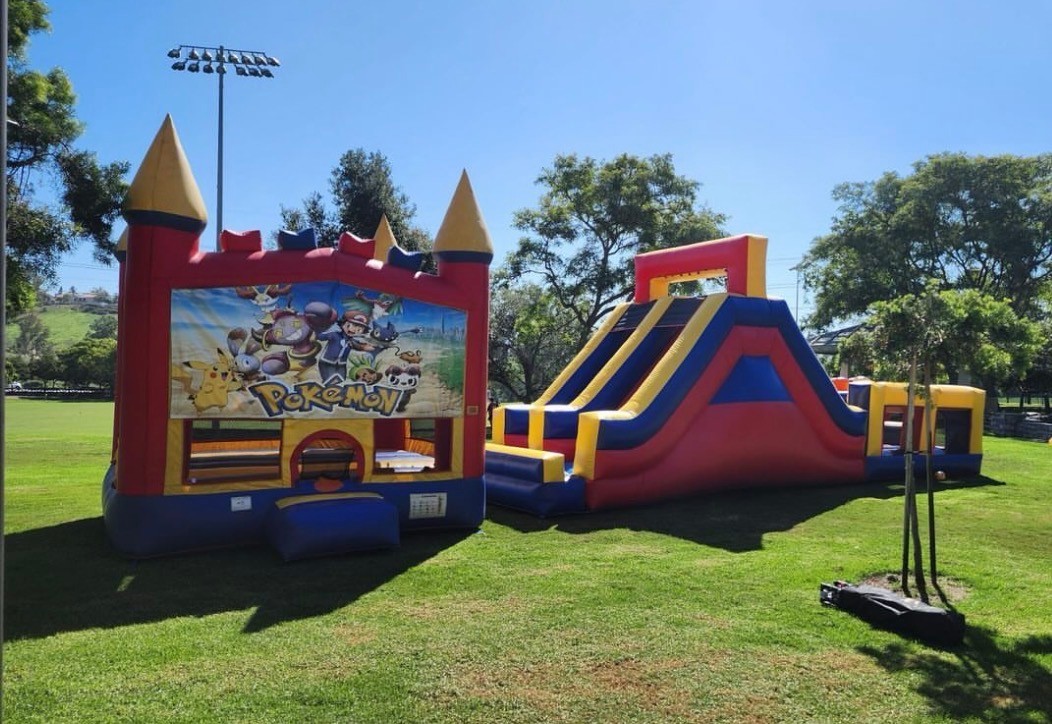
Larger setups with multiple blowers. Combo units, obstacle courses, and waterslides sometimes use more than one blower. If your rental includes a larger inflatable or a multi-piece setup, confirm with your rental company whether a single outlet can handle the load or whether a generator is the better option.
The key takeaway is that a generator is a planning tool, not a last-minute fix. Deciding early whether you need one gives you time to confirm the right size and placement before the delivery crew arrives.
What to Know About Generator Sizing Before You Book
Generator sizing is one of the most common points of confusion for first-time renters. The short version is that the generator needs to produce enough wattage to run the inflatable's blower continuously without straining.
Most standard bounce house blowers draw somewhere in the range of 1,000 to 1,500 watts during normal operation, though larger inflatables and combo units can require more. Because generators also experience a startup surge when the blower first kicks on, the generator's rated output needs to account for that brief spike as well as the steady running load.
Here is what this means practically for your booking:
- Ask your rental company for the specific wattage requirement of the inflatable you are renting before you commit to a generator size.
- A generator rated for 3,000 to 4,000 watts is a common starting point for a single standard bounce house, but your rental provider should confirm the right match for your specific unit.
- If you are renting a waterslide, obstacle course, or combo unit, the power requirement may be higher. Confirm this separately.
- Do not assume that a generator you already own or borrow is the right fit without checking the wattage against the blower's requirements.
Jump High Rentals can walk you through the power needs for any inflatable in their lineup before your delivery date. Getting that confirmation early means no surprises on the morning of the party.
Generator Placement and Safety Tips for Backyard Parties
Where you put the generator matters as much as what size you use. A few practical guidelines make the setup safer and more comfortable for everyone at the party.
Keep it away from guests and play areas. Generators produce exhaust and run warm. Position the generator at least ten feet from the inflatable and away from any area where children will be playing or gathering. A corner of the yard, behind a fence line, or along a side wall works well in most OC backyards.
Never run a generator indoors or in an enclosed space. This includes garages, covered patios with limited airflow, and side yards that are essentially enclosed corridors. Carbon monoxide from generator exhaust is a serious hazard. The generator should always be in an open, well-ventilated area.
Manage the cord carefully. Run the power cord along the edge of the yard or fence line rather than across open grass where guests walk. Use a cord rated for outdoor use and for the wattage load you are running. Secure it flat against the ground with cord covers or tape it down at edges to reduce tripping risk.
Plan for noise. Generators are not silent. If your party is in a neighborhood with close-together homes, a quieter inverter-style generator may be worth the extra cost. Let your neighbors know in advance if the event runs long, and check whether your city or HOA has noise ordinances that apply during afternoon or evening hours.
Fuel and runtime. A standard generator running a single bounce house blower will typically use a modest amount of fuel per hour, but you should confirm the expected runtime with your rental provider and have enough fuel on hand to cover the full rental period plus a small buffer.
Backyard Planning Checklist for Power-Free Inflatable Setups
Before your delivery day, a quick walkthrough of your backyard helps the setup go smoothly and confirms that the generator plan will actually work in your space.
- Measure the flat area available. Confirm that the inflatable fits with several feet of clearance on all sides. Most bounce houses need a minimum of a few feet of buffer beyond the unit's footprint.
- Check gate and access width. Delivery crews bring inflatables through side yards and gates. A standard gate opening of at least four feet wide is usually needed, though larger units may require more clearance.
- Identify the generator placement zone. Walk the yard and pick a spot that is open, away from guests, and accessible for fueling if the party runs long.
- Note the surface type. Grass, artificial turf, concrete, and pavers each have different anchoring needs. Let your rental company know what surface the inflatable will sit on so they bring the right stakes or sandbags.
- Plan for shade and heat. Orange County summers are warm. If the inflatable will be in direct sun for most of the party, consider a canopy or shade sail nearby for waiting kids and parents. This is especially relevant for waterslide setups where kids may be standing in line.
- Confirm water access for waterslides. If you are renting a waterslide, you will need a garden hose that reaches the unit. Confirm hose length and connection point before delivery.
Questions to Ask Your Rental Company Before Delivery Day
A short conversation with your rental company before the event can prevent most generator-related surprises. Here are the questions worth asking:
What is the wattage requirement for the specific inflatable I am renting? This is the most important number. Get it in writing or confirmed by email so you can match it to the generator.
Does Jump High Rentals offer generator rental or recommendations? Some rental companies can connect you with a generator option or advise on what to source locally. Ask early so you have time to arrange it.
How far can the blower sit from the inflatable and still function properly? Blower hoses have a practical length limit. Knowing this helps you plan the generator placement without putting it too close to the play area.
What type of extension cord is safe to use between the generator and the blower? Not all outdoor extension cords are rated for the same load. Your rental company can advise on gauge and length.
Are there any restrictions for the venue or event type? Schools, churches, and HOA events sometimes have their own rules about generators, noise, or fuel storage. Confirm these details with the venue and mention them to your rental company so the setup plan fits the location.
What happens if the blower loses power mid-party? Ask what the protocol is and whether the rental company provides any support if a power issue comes up during the event.
Getting clear answers to these questions before delivery day means you can focus on the party instead of troubleshooting on the morning of the event.
If you are planning a backyard birthday or community event in Orange County and want to confirm the power requirements for your specific setup, reach out to Jump High Rentals before you book. The team can walk you through what your inflatable needs, help you think through the generator plan for your yard, and make sure delivery day goes exactly the way you pictured it.