
Why Guest Count Should Drive Your Inflatable Decision
Most parents start the inflatable search the same way: they find a theme their child loves, check the price, and book it. That approach works fine until party day arrives and twenty kids are standing in a line that wraps around the yard, waiting for a bounce house built for six. Guest count is the variable that quietly controls everything else, from which unit type makes sense to how much space you actually need and whether one inflatable is even enough.
The good news is that matching your headcount to the right rental is straightforward once you know the framework. Orange County backyards range from compact Irvine townhome patios to sprawling Yorba Linda lots, and the inflatable market has units sized for every scenario. The key is starting with how many kids will be at your party before you look at anything else. Once you lock in that number, the unit type, the footprint, and the rental budget all fall into place much more naturally.
If you are still in the early planning stages, the Jump High Rentals FAQ covers common sizing and booking questions that can help you frame your options before you dive deeper into the details below.
Matching Inflatable Size and Type to Your Headcount
Think of inflatable capacity in three broad tiers, and remember that capacity describes how many children can play safely at the same time, not how many kids will attend the party overall.
For gatherings where roughly four to twelve children will be present, a standard bounce house in the 10x10 to 13x13 footprint range handles the crowd comfortably. These compact units safely hold four to six kids at once, which means a group of ten can rotate through with short waits and plenty of energy to spare. Toddler-focused parties fit especially well here because smaller units have lower walls, gentler entry steps, and a contained play area that keeps little ones from wandering. If your child is turning three or four and the guest list is mostly preschool friends, a single standard jumper is almost always the right call.
The middle tier covers parties with roughly twelve to twenty-five children. At this range, a combo unit earns its keep. Combo bouncers pair a jumping chamber with a built-in slide, climbing wall, or basketball hoop, which means kids have two or three activities in one footprint. Because the unit offers variety, children naturally spread across the different features rather than all piling into the same chamber at once. That self-distribution keeps lines short without requiring you to rent multiple units. Combo units typically run $250 to $450 per day in Orange County, and they are among the most popular choices for elementary-age birthday parties where kids range from five to ten years old.
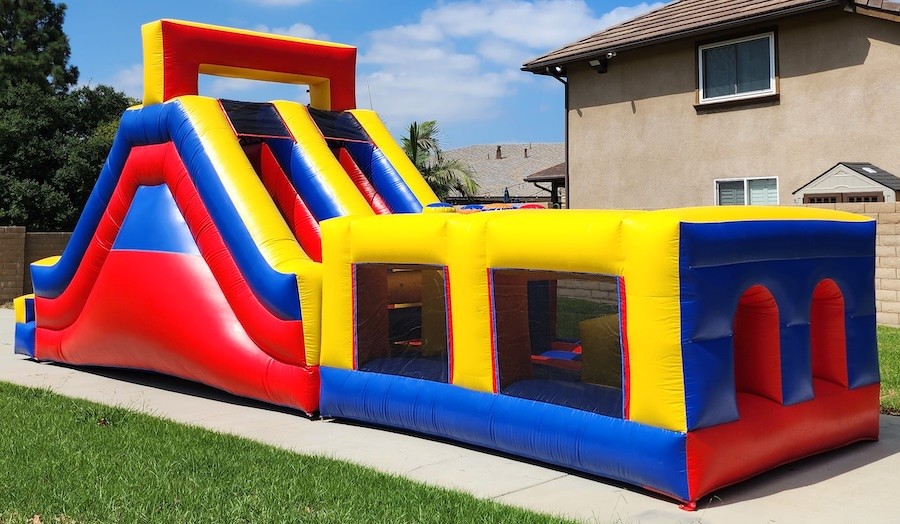
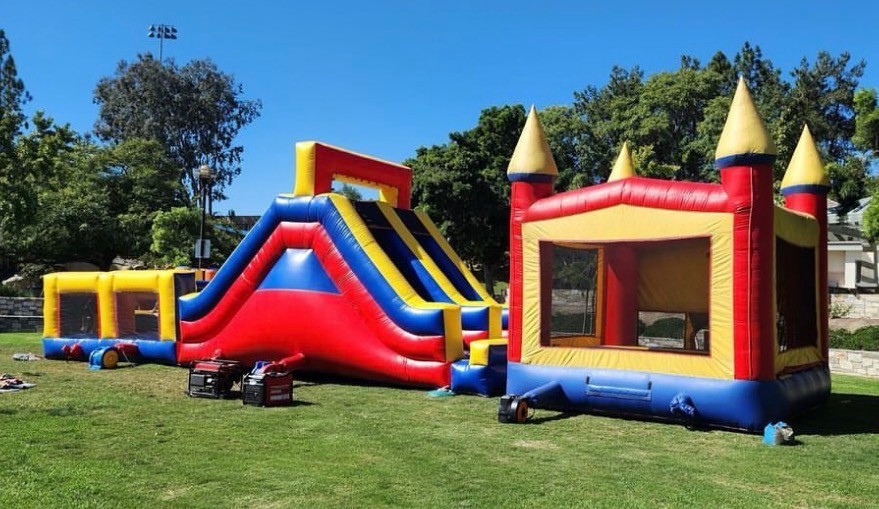
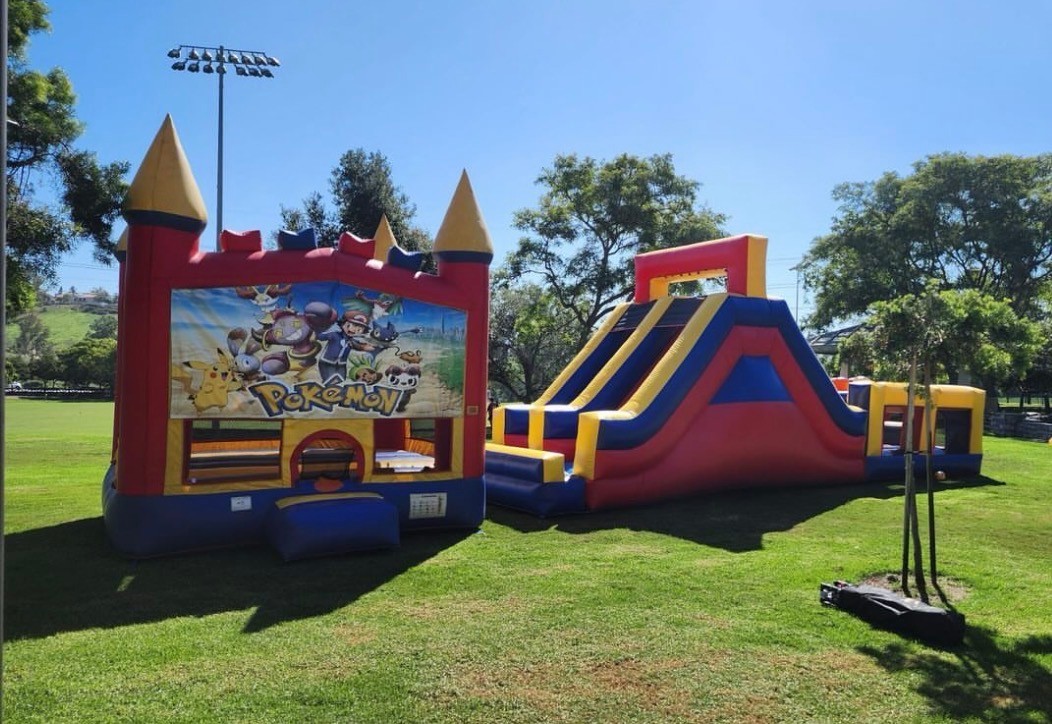
Once your guest list climbs above twenty-five children, the math shifts. A single inflatable, even a large combo unit, will create bottlenecks. This is where obstacle courses and multi-unit setups become the practical choice. An obstacle course accommodates two to four participants at a time in a competitive, timed format, which keeps kids engaged even when they are waiting because they are watching and cheering. Pairing an obstacle course with a standard bounce house gives a large group two distinct activity zones and dramatically reduces idle time. You can explore how these setups compare in the obstacle course vs. bounce house guide for a side-by-side look at which format fits different party styles.
Pricing context matters here too. Standard jumpers in Orange County typically start around $159 to $200 per day. Obstacle courses generally begin at $400 and climb from there depending on length and features. For large events, that investment pays off in a smoother experience where kids stay active and parents stay relaxed.
Space Requirements for Every Group Size in OC Backyards
Guest count and space requirements are closely linked, but they are not the same thing. You might have thirty kids coming to a party in a Laguna Hills backyard that can only fit a 15x15 footprint, which means your unit type decision gets made partly by the yard, not just the headcount. Understanding both constraints together is what leads to a good booking.
A standard bounce house needs a minimum flat, level area of roughly 20 feet by 20 feet to set up safely. That footprint accounts for the unit itself plus the clearance space the crew needs to stake, anchor, and run the blower. Overhead clearance matters too: plan for at least 15 feet of vertical space free of tree branches, power lines, and overhangs. If your yard is tight, measure before you book rather than after. The backyard sizing guide walks through exactly how to measure your space and what to do if the numbers are close.
Combo units require more ground space, often 20 feet by 25 feet or larger depending on the specific model. Obstacle courses are the most space-intensive option, with longer units running 50 feet or more in length. If you are working with a smaller yard but have a larger guest count, the practical solution is often a mid-size combo unit with a structured rotation schedule rather than trying to squeeze an obstacle course into a space that cannot safely hold it.
Sloped yards add another layer of complexity. Orange County hillside neighborhoods, particularly in areas like Anaheim Hills, Rancho Santa Margarita, and parts of Mission Viejo, often have yards with noticeable grade changes. Inflatables require a level surface to operate safely, so a yard with more than a slight slope may need a different placement strategy or a different unit altogether. The sloped backyard setup guide covers what to check before you confirm your booking if your yard has any incline.
For park events, the space equation changes because you typically have more room to work with, but you also need to account for permit requirements. Most Orange County public parks require a permit for inflatable rentals, and the application process generally takes two to four weeks. Permit fees typically range from $35 to $125 depending on the park and the city. You will also need a generator since most park locations do not have accessible power outlets. The OC park permit guide has a step-by-step breakdown of the process for common Orange County parks.
Large Group Strategies: Schools, HOAs, and Community Events
When the guest count climbs into the fifty-plus range, the planning approach shifts from "which unit" to "how many units and how do we manage flow." Schools, HOAs, and churches hosting community events face this challenge regularly, and the solution almost always involves multiple inflatables positioned to create distinct activity zones.
A practical setup for a school field day or HOA block party with fifty to seventy-five children might include one large obstacle course, one combo bounce house, and one standard jumper designated for younger children. That three-unit configuration gives kids age-appropriate options, keeps groups separated by activity type, and prevents any single unit from becoming overwhelmed. Supervision becomes easier too because each zone has a natural boundary.
For events approaching one hundred guests or more, the multi-unit inflatable planning guide offers a detailed framework for spacing, power requirements, and staffing considerations. The inflatable rental checklist for OC parties with 50 guests is also a useful companion document if you are coordinating a large event and want a structured planning tool.
One detail that catches many event planners off guard is power. Each inflatable requires a dedicated circuit, and running multiple units simultaneously means either multiple power sources or a generator with sufficient output. The power and extension cord guide explains what to plan for so you are not scrambling on setup day.
For HOA events specifically, the approval process often requires documentation of the rental company's insurance coverage. While Jump High Rentals carries liability insurance and can provide documentation to support your HOA's process, the specifics of what your HOA requires are between you and your association. Start that conversation early, ideally four to six weeks before your event date, so there is time to gather any paperwork the board needs.
Frequently Asked Questions About Guest Count and Inflatable Rentals
How do I count guests for sizing purposes? Count only the children who will actually use the inflatable, not the total number of people attending. Adults typically do not use bounce houses, and older teens may prefer other activities. Focus your sizing decision on the number of kids between roughly three and twelve years old.
What if my guest count is right on the border between unit types? When you are between tiers, the safer choice is usually to size up. A slightly larger unit with shorter wait times creates a better experience than a unit that is technically adequate but creates frustration. If budget is a concern, discuss your headcount with the Jump High team and they can suggest the most efficient option for your specific situation.
Can I add a second unit after I book? Availability permitting, yes. That said, adding a second unit is easier to plan for in advance than to arrange last minute, especially during peak summer weekends in Orange County when inventory moves quickly. If you think you might need two units, mention it when you first reach out so the team can hold the right combination for your date.
Does the type of event change the recommendation? It does. A birthday party with a single age group is easier to plan for than a community event with mixed ages. When you have toddlers and ten-year-olds at the same event, separating them into age-appropriate units is a safety best practice, not just a convenience. Younger children should always have a designated unit with lower walls and gentler features rather than sharing space with older, heavier kids.
What is the best way to get a personalized recommendation? The most reliable approach is to share your guest count, the ages of the children attending, and your yard dimensions when you reach out. The Jump High Rentals contact page makes it easy to send those details directly, and the team can point you toward the right unit or combination from the full rentals catalog based on what is actually available for your date.
Starting with your headcount, then layering in your space and your budget, is the approach that leads to a party where kids stay active, lines stay short, and you spend the afternoon enjoying the celebration instead of managing chaos. Browse the catalog, share your numbers, and let the unit selection follow from there.