
Why Guest Count Comes Before Everything Else
The most common planning mistake OC parents make is falling in love with a unit's color scheme or theme, booking it, and then realizing on party morning that twenty-five kids are waiting in line for a bounce house built for eight. Guest count is the single most reliable starting point for choosing an inflatable because it determines how long each child waits, how safely the unit can be used, and whether the energy of your party stays high from the first jump to the last.
Every commercial inflatable carries a manufacturer capacity rating, and that number is not a suggestion. It reflects the interior jumping surface area, the weight load the floor can safely handle, and the clearance needed so kids aren't colliding mid-bounce. When you start your planning with a headcount instead of a wish list, you give yourself a real filter. A unit that looks gorgeous in a photo but holds only six kids at a time will create a frustrating bottleneck at a party of thirty. Starting with the number of children attending lets you rule out undersized units immediately and focus your budget on something that actually fits your crowd.
A practical rule of thumb: plan for roughly one-third to one-half of your child guests to want access to the inflatable at any given moment during peak party time. If you have twenty kids coming, you want a unit that can comfortably hold eight to ten at once so rotation stays smooth and no one is standing in a long line while cake is being cut.
Matching Inflatable Size to Your Crowd: The OC Backyard Reality
For most Orange County backyard birthdays, the crowd falls somewhere between ten and thirty kids. That range covers the majority of school-friend parties, neighborhood gatherings, and family celebrations you'll host in a typical Irvine tract home or a Costa Mesa side yard. Knowing where your headcount lands in that range tells you almost everything about which unit category to consider.
A standard bounce house in the 13-by-13-foot range works well for parties with ten to fifteen younger children, typically ages three to seven. The jumping surface is generous enough for that group without overwhelming a smaller yard. If your list climbs toward twenty kids, you'll want to look at a larger bounce house in the 15-by-15 or 15-by-18 range, which opens up the interior and reduces the bottleneck at the entrance. You can explore the full range of options on the Jump High Rentals catalog page to compare footprints side by side.
For parties pushing twenty-five to thirty kids, a standard bounce house often starts to feel cramped even if the unit technically fits the yard. This is where many parents discover they need a different category of inflatable entirely, not just a bigger version of the same thing. The guide to picking the right bounce house size for your backyard walks through the footprint math in detail, but the short version is this: more kids means more simultaneous activity, and that calls for more square footage of jumping surface, not just a taller or flashier unit.
Age mix matters too. A party with a wide age range, say toddlers through ten-year-olds, benefits from a unit with separate activity zones or a gentler slide exit so older kids aren't inadvertently landing on younger ones. If your guest list is age-diverse, factor that into your size conversation when you reach out to book.
When to Upgrade: Combo Units, Obstacle Courses, and Waterslides
When your guest count crosses twenty-five kids or your crowd skews older (ages seven and up), a standalone bounce house often stops being the best value. Combo units, obstacle courses, and waterslides each solve the crowd problem differently, and understanding which one fits your situation saves you from overspending on the wrong upgrade.
A combo unit pairs a bounce area with a slide and sometimes a basketball hoop or climb wall. Because kids can cycle through multiple activities, the effective throughput is higher than a bounce-only unit of the same footprint. A party of twenty-five kids in an Anaheim backyard with a combo unit will feel much more fluid than the same crowd on a smaller bounce house, because children naturally spread across the different features. The combo bounce house versus standalone slide guide covers this tradeoff in detail if you want to dig deeper.
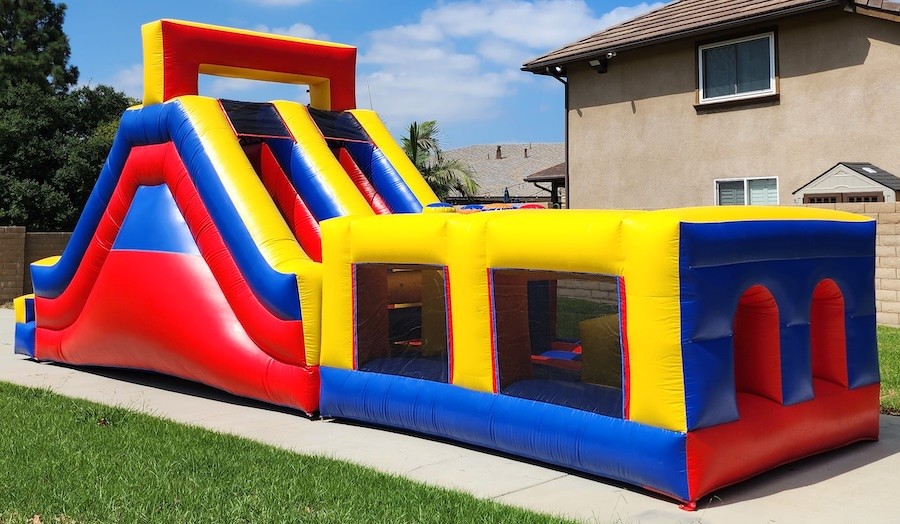
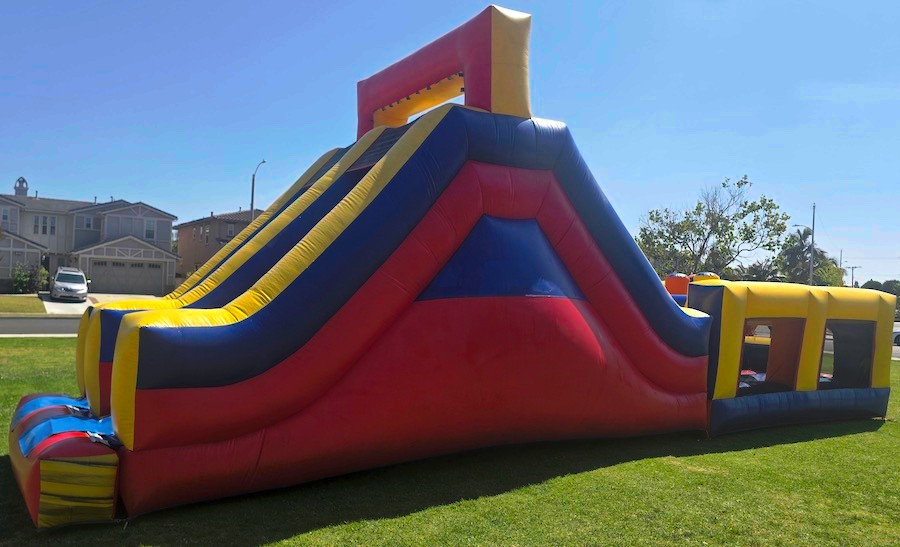
Obstacle courses are the right call when your guest list is heavy on kids ages eight and up. Older kids lose interest in open bouncing faster than younger ones, but they'll run an obstacle course repeatedly and turn it into a competition. A 30-foot or 40-foot inflatable obstacle course keeps a crowd of thirty-plus engaged for the full party window without the line frustration of a bounce house. You can read more about this option in the obstacle course versus bounce house guide.
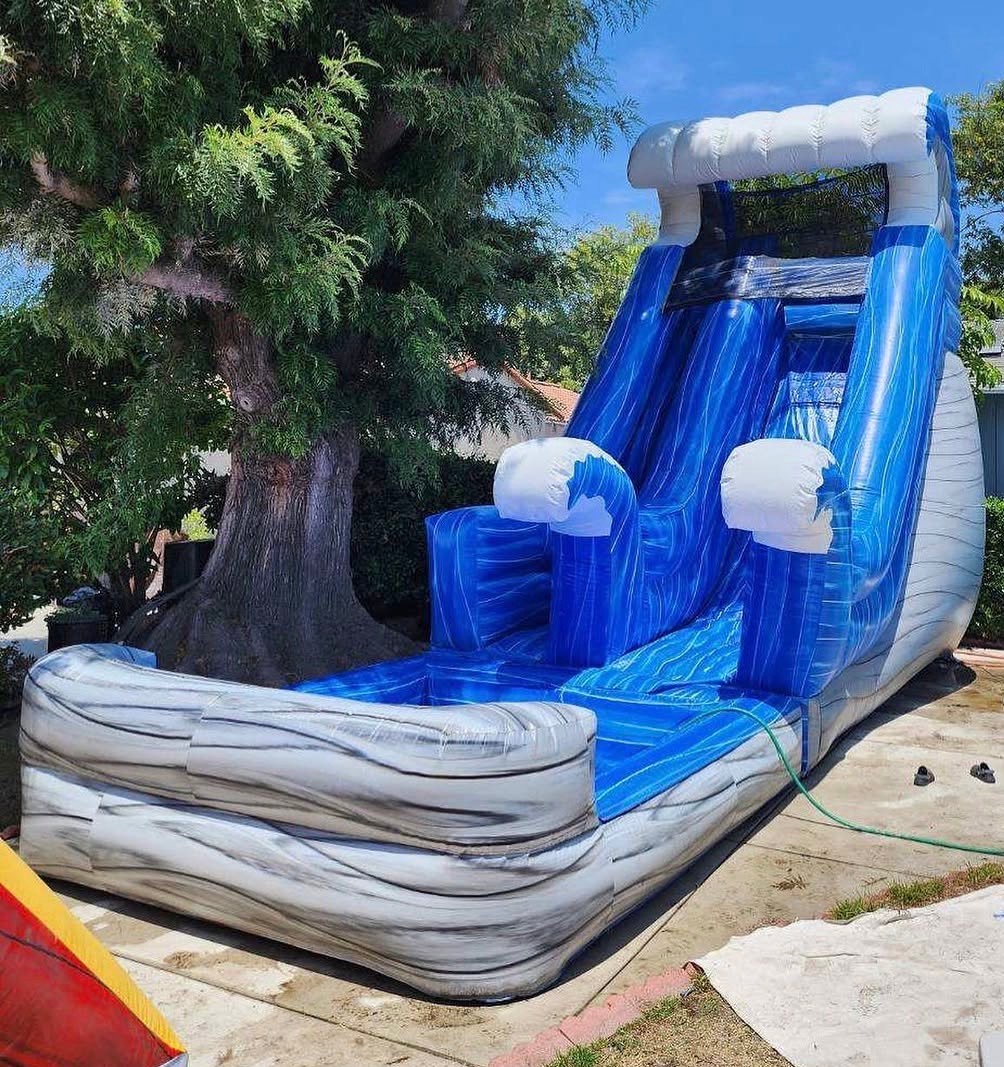
For summer parties, a waterslide or combo waterslide unit solves the crowd problem and the heat problem at the same time. Kids naturally pace themselves on a waterslide because the climb and slide cycle creates its own rhythm. A dual-lane waterslide effectively doubles your throughput compared to a single-lane unit, which matters a lot when you have thirty kids and a two-hour party window. If you're planning a warm-weather event, the bounce house and waterslide combo guide for OC summer is a helpful next read.
Space Math: Fitting Your Inflatable in a Typical OC Yard
Guest count and unit size are only half the equation. The other half is whether your yard can physically hold the inflatable you need. Orange County backyards vary enormously, from the generous lots in Yorba Linda and Anaheim Hills to the compact patios common in newer Irvine developments and older Costa Mesa neighborhoods. Getting the space math right before you book prevents the painful scenario of a delivery crew arriving with a unit that won't fit through your side gate.
Most standard bounce houses need a clear footprint of about 15 by 15 feet at minimum, plus a few feet of buffer on each side for staking and blower placement. A combo unit typically needs 20 by 20 feet or more. An obstacle course can run 15 by 40 feet or longer depending on the model. Before you finalize your booking, measure your usable outdoor space and note any obstacles: low-hanging branches, patio covers, utility boxes, or sloped ground. The sloped backyard guide is worth reading if your yard isn't flat, because slope affects both safety and setup options.
Also measure your access path. The delivery team needs to move the inflatable from the truck to your setup area, and most units travel on a dolly that requires a clear path of at least four feet wide. A narrow side gate or a step-heavy entry can limit which units are physically deliverable to your space. When in doubt, share your yard dimensions and access details when you contact Jump High so the team can flag any potential issues before delivery day.
The goal is to match the right unit to both your guest count and your actual yard, not to squeeze the largest possible inflatable into a space where it barely fits. A well-chosen unit in a yard with room to breathe is always a better party experience than an oversized unit that leaves no room for tables, shade, or the kids who aren't jumping.
Booking the Right Size Without Overspending
Bigger is not always better, and the most expensive unit is not automatically the right one for your party. The goal is to match capacity to your actual headcount so you're not paying for unused square footage or, worse, under-serving your crowd with a unit that's too small.
If your guest count is firm and on the smaller side (ten to fifteen kids), a well-maintained standard bounce house is genuinely the right call. It fits most OC backyards, it's easy to supervise, and it keeps your budget in a comfortable range. If your count is closer to twenty-five and your yard can handle it, a combo unit or a larger bounce house is worth the step up because it prevents the line frustration that can derail a party's energy.
One practical tip: book based on your confirmed guest count, not your invited count. Kids' parties in Orange County typically see a 70 to 80 percent attendance rate on RSVPs, so if you've invited thirty kids and confirmed twenty-two, plan for twenty-two. That number is your real planning anchor.
Booking early also gives you more size options. Peak summer weekends in OC fill up fast, and the most popular combo units and waterslides go first. The guide on how far ahead to book inflatable rentals in OC gives you a clear timeline so you're not left choosing from whatever's left two weeks before your party date.
Not sure which size fits your guest list? Browse the Jump High Rentals catalog to see unit footprints and capacity details, or reach out directly and the team will help you match the right unit to your headcount, your yard, and your budget. Getting this decision right before booking day makes everything else, setup, supervision, and the party itself, run a whole lot smoother.