
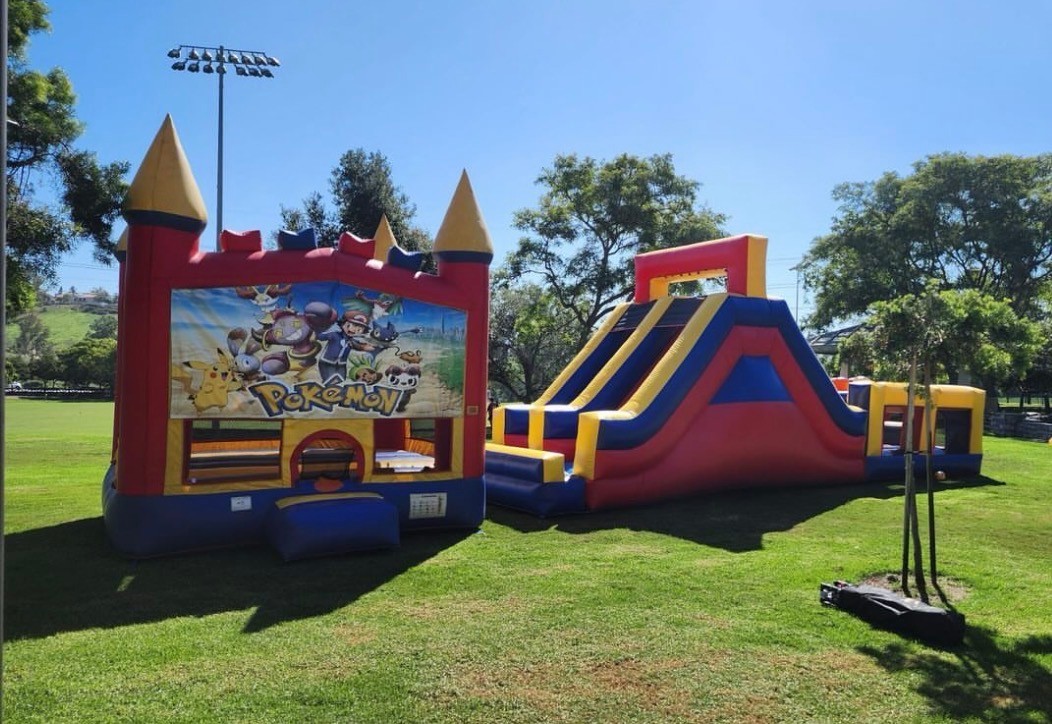
If you just had artificial turf installed in your Orange County backyard, you already know the investment is worth it. No muddy patches, no dead grass after a hot summer, and a clean surface that looks great year-round. But when a birthday party is coming up and you want to rent a bounce house or waterslide, a reasonable question comes up: will the anchoring damage my turf?
The short answer is no, as long as the right anchoring method is used. This guide walks you through exactly what that looks like, what to avoid, and how Jump High Rentals handles setup so your turf stays in great shape from the moment we arrive to the moment we pack up.
Why Artificial Turf Needs a Different Anchoring Approach
Natural grass can handle ground stakes driven into the soil beneath it. The grass blades flex, the soil absorbs the stake, and when the stake comes out, the lawn recovers. Artificial turf does not work the same way.
Artificial turf is a layered system. There is a backing material, drainage holes, and often an infill layer (commonly silica sand or crumb rubber) that gives the surface its cushioned feel. When you drive a nail, stake, or U-staple through the turf to anchor an inflatable, you are puncturing that backing. Even a small hole can tear the fibers around it under the dynamic load of kids jumping inside a bounce house. Over time, those small punctures can become larger tears, and some turf warranties are voided by this kind of damage.
This is why the party rental industry has moved toward weighted anchors for artificial turf setups. Instead of penetrating the surface, weighted anchors sit on top of or beside the inflatable's anchor loops and hold it down through sheer mass. No holes, no tears, no warranty headaches.
There is also a safety reason that goes beyond protecting your turf. Inflatables need to be anchored firmly because wind can catch them, especially in OC's coastal and inland areas where afternoon gusts are common. A properly weighted anchor system keeps the unit stable throughout the party, which protects the kids inside just as much as it protects the grass underneath.
The Right Way to Use Weighted Anchors on Turf
Weighted anchoring done correctly is not complicated, but it does require attention to a few details.
Use heavy, dense sandbags. Lightweight objects like empty buckets or decorative planters do not provide enough downward force to counteract wind or the movement of active kids. Purpose-built sandbags designed for inflatable anchoring are the standard. They are heavy enough to hold firm and compact enough to sit neatly at each anchor point.
Cover all four corners, at minimum. Every inflatable has anchor loops built into the base. At a minimum, each corner loop needs a sandbag. For larger units like obstacle courses or combo waterslides, additional anchor points along the sides are also recommended to distribute the load evenly.
Choose sandbags with smooth edges. Rough or sharp-edged weights can scratch the turf surface during placement or removal. Smooth, rounded sandbags are gentler on the fibers and easier to reposition if needed.
Check stability before inflating. Once the sandbags are placed, give each anchor point a firm tug to confirm it holds. If the inflatable shifts noticeably, add more weight before the blower goes on. It is much easier to adjust anchors before the unit is fully inflated than after.
Be mindful of the infill. Some OC backyards have turf with a silica sand infill layer that adds natural weight and cushioning. When placing sandbags, set them down gently rather than dragging them across the surface. Dragging can displace the infill and create uneven spots that affect how the turf performs after the party.
A quick note on wind: weighted anchors are the right tool for typical party conditions, but no anchor system is designed for extreme gusts. If the weather forecast shows high winds on your party day, talk to your rental provider about the safest course of action. Jump High Rentals can help you think through the options.
What to Avoid: Anchoring Methods That Can Damage Your Turf
Knowing what not to do is just as important as knowing the right approach. Here are the anchoring methods that can cause real damage to artificial turf.
- Ground stakes and rebar: These are standard for natural grass setups but will puncture the turf backing and potentially damage the drainage layer beneath.
- Nails or screws: Even small fasteners create holes that can expand under load. There is no such thing as a "small enough" nail when it comes to turf backing.
- U-staples: Turf U-staples are designed to secure turf seams to soil during installation. They are not meant to anchor inflatables and can rip the surface under the repeated stress of a bounce house in use.
- Lightweight improvised weights: Decorative rocks, empty coolers, or folding chairs do not provide consistent, reliable hold. If a weight shifts or tips over, that anchor point is effectively lost.
- Tying directly to turf seams: If your turf has visible seams, never run a tether line across or through a seam. The tension can pull the seam apart.
If a rental company arrives at your home and reaches for ground stakes without asking about your surface, that is a good moment to speak up. A setup crew experienced with OC backyards will ask about the surface before unloading equipment.
How Jump High Rentals Handles Setup on Artificial Turf
When you book with Jump High Rentals, setup and pickup are included with every rental. That means our crew handles the anchoring, not you.
Before we place any equipment, we assess the surface. If your backyard has artificial turf, we use weighted anchors rather than ground stakes. We bring the sandbags, we position them at each anchor point, and we check stability before the blower goes on. You do not need to source your own weights or figure out placement on your own.
We also take care during placement to avoid dragging equipment across the turf surface. Inflatables are unrolled and positioned carefully, and sandbags are set down rather than slid into place. When the party is over and we come back for pickup, we remove the weights and roll up the inflatable in a way that does not disturb the turf fibers or infill.
If you have questions about your specific turf type or want to let us know about any areas of the yard to avoid (like a putting green section or a freshly seamed repair), just mention it when you book or when our crew arrives. The more we know about your setup, the smoother the installation goes.
Extra Safety Checks Before the Party Starts
Even with proper anchoring in place, a few quick checks before the first kid climbs in can make the whole party run more smoothly.
Walk the perimeter of the inflatable. Look at each anchor point and confirm the sandbags are sitting flat and have not shifted during inflation. The blower creates movement as the unit fills with air, and occasionally a sandbag will need to be repositioned.
Check the turf around the base. Make sure no turf fibers have been folded under the inflatable's base skirt. If fibers are trapped, they can be damaged by the weight and movement of the unit over several hours.
Look at the blower placement. The blower tube connects to the inflatable and should rest on a flat surface. If it is sitting at an awkward angle on the turf, adjust it so the tube runs smoothly and does not create a tripping hazard near the entrance.
Set a clear entry and exit point. Kids running around the outside of an inflatable can trip on anchor lines or sandbags. Designating one side as the entry and exit area, and keeping the other sides clear of foot traffic, reduces that risk.
Assign an adult supervisor. Anchoring keeps the inflatable stable, but it does not replace active supervision. One adult watching the unit at all times is the single most effective safety measure at any inflatable party.
Your artificial turf is a real investment, and it deserves to be treated that way during a party. With the right anchoring approach and a setup crew that knows what they are doing, you can have a bounce house or waterslide in your OC backyard without worrying about the surface underneath.
Ready to book? Jump High Rentals serves families, schools, churches, and HOAs across Orange County. Our team handles setup and pickup, uses weighted anchors on artificial turf, and makes sure everything is stable before the party starts. Give us a call or book online and let us take care of the details so you can focus on the fun.