
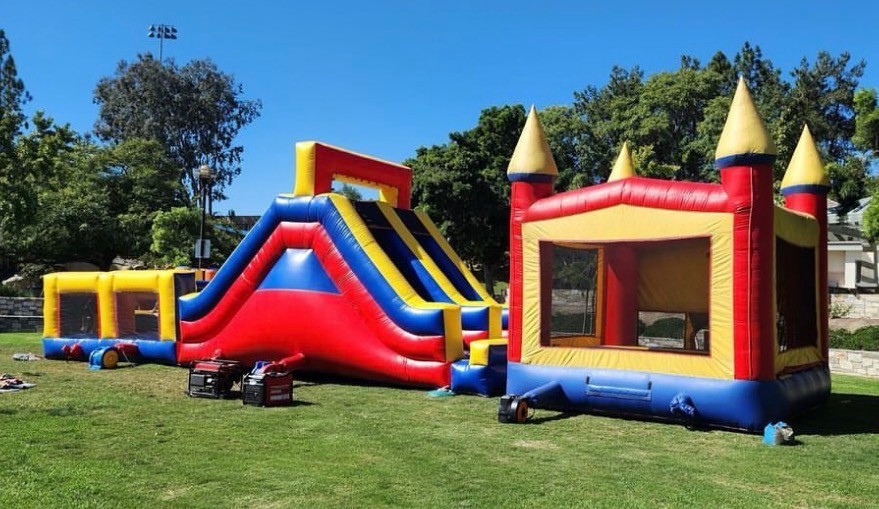
Booking an obstacle course for a backyard party sounds straightforward until you realize the unit you had in mind is three feet wider than your side gate. Sizing an inflatable obstacle course for a residential yard in Orange County takes a little more thought than picking a bounce house, and the good news is that a simple measurement-first approach makes the whole process much easier. This guide walks you through exactly what to measure, how to match course length to your crowd, and which details most families overlook before delivery day.
Why Backyard Obstacle Course Sizing Is Different From Bounce House Sizing
A standard bounce house is a compact square or rectangle. Most residential units fall somewhere between 13 and 15 feet on each side, which means they fit comfortably in a wide range of Orange County backyards with room to spare. An obstacle course is a completely different shape. It is long and narrow, often running anywhere from 20 to 40 feet in length while staying relatively slim in width (typically 9 to 11 feet wide). That shape changes everything about how you plan your yard layout.
The length is what catches most parents off guard. A 40-foot obstacle course needs a setup area closer to 45 feet long once you account for blower placement, staking, and safe clearance at each end. A more compact 28-foot unit still needs roughly 30 to 32 feet of clear, flat ground. Neither of those measurements includes the space kids need to line up, wait their turn, and exit safely without crowding the inflatable itself.
Obstacle courses also tend to be taller than a basic bounce house. Many residential units reach 11 to 12 feet in height, so overhead clearance matters too. Low-hanging branches, patio covers, and string lights all need to be factored in before you commit to a placement spot.
How to Measure Your Usable Backyard Space Before You Book
The most common mistake families make is measuring the total backyard rather than the usable footprint. Your yard might be 50 feet deep on paper, but once you subtract the patio, the built-in BBQ, the trampoline, the garden beds, and the tree in the corner, you may have 28 feet of genuinely open, flat space. That is the number that matters.
Here is a practical way to measure before you call a rental company:
- Walk your yard and identify the largest continuous flat area, free of slopes, roots, and fixed structures.
- Measure that area in two directions: length (the longest straight run) and width (how wide that run stays without hitting an obstacle).
- Note any elevation changes. Even a gentle slope across 30 feet can affect how an inflatable sits and anchors.
- Check overhead clearance if you have a patio cover, pergola, or mature trees near the open area.
- Measure your gate opening and any side-yard passage the delivery crew will use to bring the unit in.
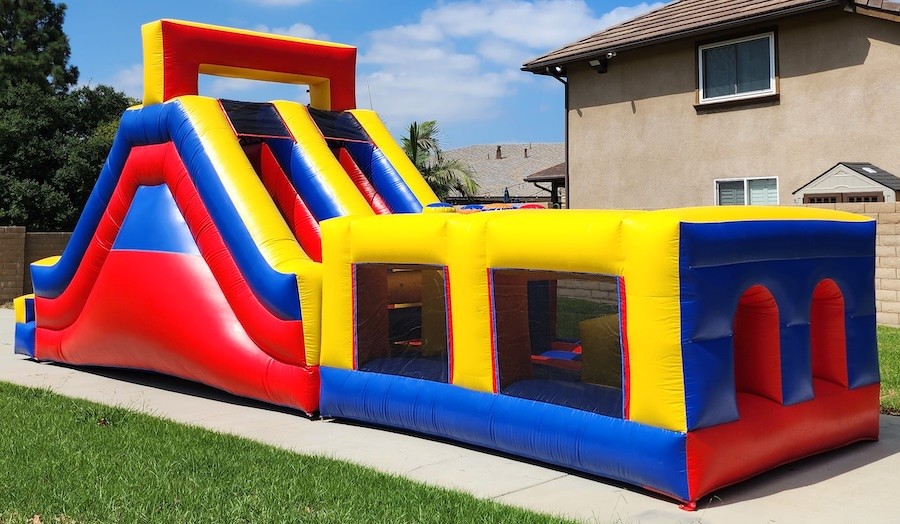
That last point is critical. A 9-foot-wide obstacle course cannot fit through a 6-foot gate, and most inflatables arrive rolled or folded but still require a clear path to the setup spot. If your only access is a narrow side yard, share those measurements with your rental company before booking so they can confirm the unit will fit.
A good rule of thumb: take your measured usable length and subtract at least 3 to 5 feet to give yourself a comfortable buffer for clearance, staking, and safe exit space. If your open run is 35 feet, plan for a course no longer than 30 to 32 feet.
Matching Course Length to Age Mix and Guest Count
Once you know your usable space, the next question is whether the course length actually fits the age group you are hosting. These two factors do not always point to the same answer, and balancing them is where a little extra thought pays off.
For younger children (roughly ages 3 to 7), a shorter course in the 20 to 28 foot range is usually the better fit. Smaller kids move through obstacles more slowly, tend to need more supervision at each element, and can get frustrated or stuck on a course designed for older kids. A compact layout keeps the action visible from one spot and makes it easier for parents to assist without climbing inside.
For older kids (ages 8 and up) or a mixed-age group, a 30 to 40 foot course gives everyone more to do and reduces the bottleneck effect when multiple kids are on the course at once. Longer courses with more obstacles keep older kids engaged longer and give the event more replay value throughout the party.
Guest count also plays a role, but it is less about total headcount and more about how many kids will be active at the same time. Most residential obstacle courses are designed for one or two kids running through at a time. If you have 20 kids at the party, a longer course with more sections helps manage the flow and keeps wait times shorter. If you have 8 kids, a compact 20 to 28 foot course is plenty.
Delivery Access and Power: Two Factors Most Families Overlook
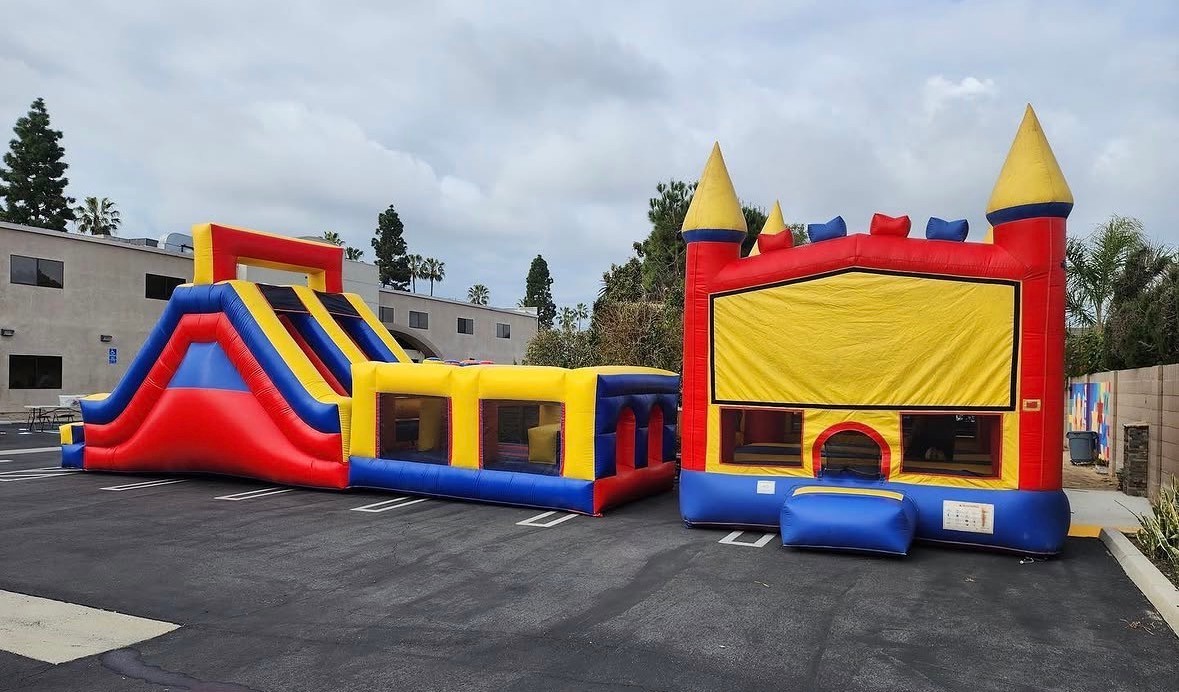
Two practical details tend to surprise first-time renters, and both are worth sorting out before booking day.
The first is delivery access. Obstacle courses are long, and even when rolled for transport, they require a clear path from the street or driveway to the setup location. Measure your gate width and note whether the path from the gate to the setup spot is straight or involves tight turns around corners of the house. Share this information with your rental company so the crew arrives prepared. Jump High Rentals handles delivery and setup across Orange County, and a quick conversation about your yard layout before booking day helps everything go smoothly.
The second is power. Every inflatable obstacle course runs on a continuous blower that needs to stay plugged in throughout the event. That blower draws a meaningful amount of power, and the outlet needs to be within reach of the setup location (typically within 50 to 100 feet, depending on the extension cord your rental company provides). Avoid running cords across high-traffic areas where guests might trip, and confirm with your rental company what cord length is included and whether a dedicated circuit is recommended for the blower.
If your yard's only outdoor outlet is on the far side of the house from your open setup space, plan for that before the crew arrives. It is a simple fix when you know about it in advance.
Choosing Between a Compact and a Full-Size Course for CA Backyards
For most Orange County residential yards, a compact to mid-size obstacle course in the 20 to 30 foot range is the most practical starting point. These units fit through standard gates, work well in typical suburban backyards, and are easier to supervise for mixed-age groups. A unit measuring around 9 feet wide by 28 feet long, for example, needs a setup footprint of roughly 9 by 28 feet plus clearance, which is manageable in a yard with 35 or more feet of open run.
A larger 40-foot course is a great choice when the yard is genuinely spacious, the setup area is very clear, and the guest list skews toward older kids or includes a larger crowd. These units make a strong impression and keep kids busy longer, but they require more room, more clearance, and a bit more coordination on delivery day.
If you are unsure which size fits your specific yard, the easiest next step is to share your measurements with a local rental company before you book. The team at Jump High Rentals is happy to talk through your backyard layout, guest count, and age mix to help you find the right fit. Reach out before your event date, especially during busy summer weekends in Orange County, so you have time to confirm availability and plan the setup details without any last-minute surprises.