
Why Guest Count Is Your Starting Point
When you sit down to book a bounce house, the first question most parents ask is "what size do I need?" But the better starting question is actually "how many kids will be jumping at the same time?" Those two questions sound similar, but they lead to very different decisions.
A party with 20 kids on the guest list does not mean 20 kids will be inside the inflatable at once. Kids rotate in and out, take snack breaks, open presents, and wander over to the cake table. In practice, you might have six to ten kids actively jumping at any given moment, even at a lively 20-kid party. That rotation pattern is what determines which unit size actually works for your crowd.
Guest count still matters as your starting point because it sets the upper boundary. If you book a unit sized for six kids and your party has 20 guests, you will spend the afternoon managing a long line of frustrated, waiting children. On the other hand, if you book a unit sized for 30 kids when you only have 12 guests, you may end up with a bounce house that takes up most of your yard and leaves no room for tables, a food area, or parents to sit comfortably.
The sweet spot for a 10 to 20 kid party is a unit that can comfortably hold eight to twelve kids at once, which gives you enough capacity to keep the line moving without overwhelming your backyard. You can read more about how manufacturers set those numbers in the inflatable capacity limits guide, which explains the difference between maximum capacity and comfortable active-use capacity.
What Bounce House Sizes Actually Mean for 10 to 20 Kids
Bounce houses are typically described by their footprint dimensions, and the most common sizes you will encounter fall into a few practical categories. Understanding what those dimensions mean in real terms helps you match the unit to your party without second-guessing yourself.
A 13x13 bounce house is the most common entry-level size. It fits comfortably in most standard backyards and can handle four to six kids jumping at one time. For a party of 10 to 12 kids, this size works reasonably well if your crowd is younger (think ages three to six) and the kids are smaller. Younger children also tend to take more breaks, so the rotation stays manageable. If your guest count is closer to 15 or your kids are in the seven to ten age range, a 13x13 will start to feel tight during peak jumping moments.
A 15x15 bounce house is a noticeable step up. It comfortably holds six to eight kids at once and suits parties in the 12 to 18 kid range very well. This is the size that tends to hit the sweet spot for the typical Orange County backyard birthday. It gives kids enough room to actually bounce without bumping into each other constantly, which is both safer and more fun. Most standard OC backyards can accommodate a 15x15 with room left over for a table setup.
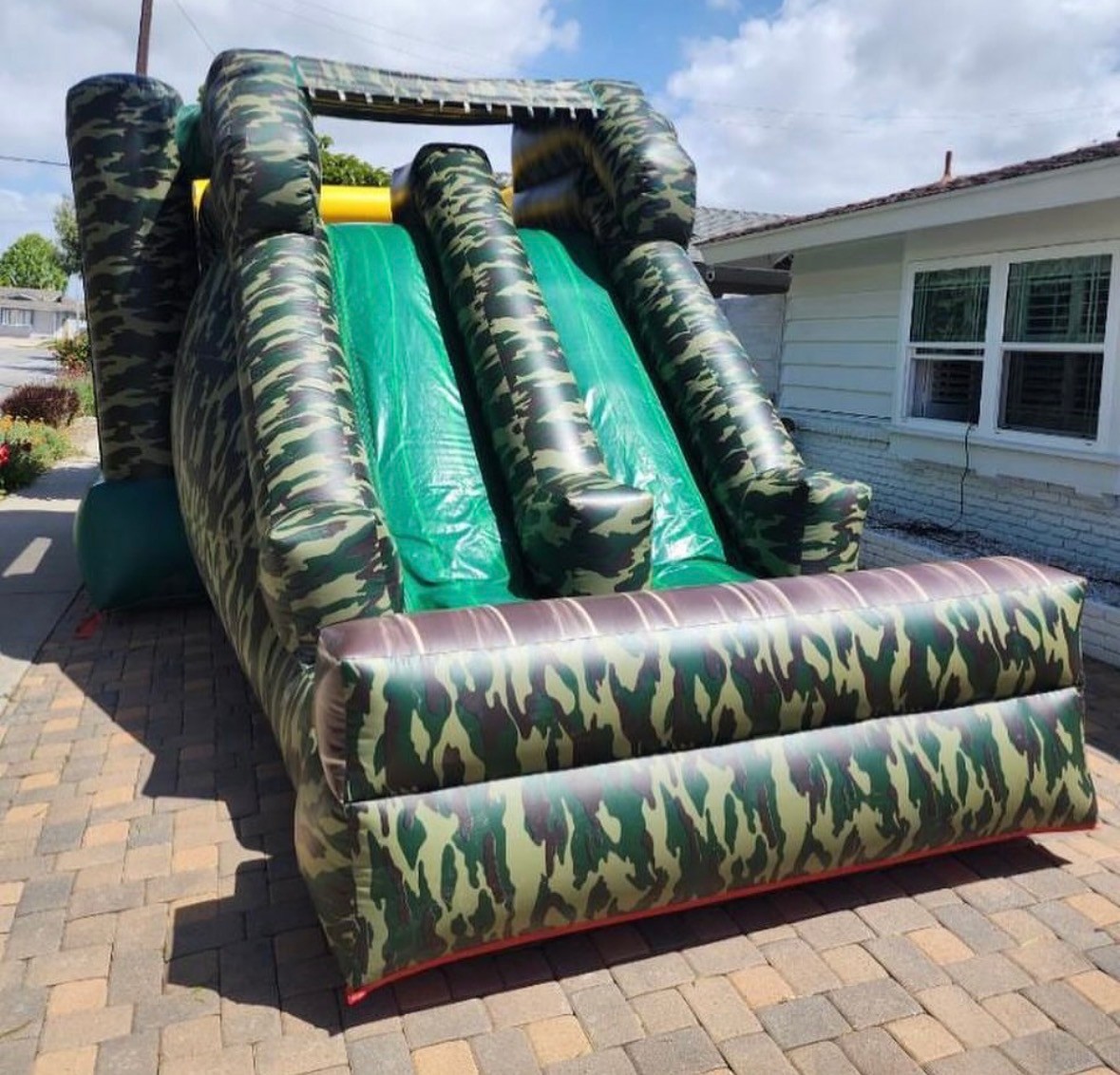
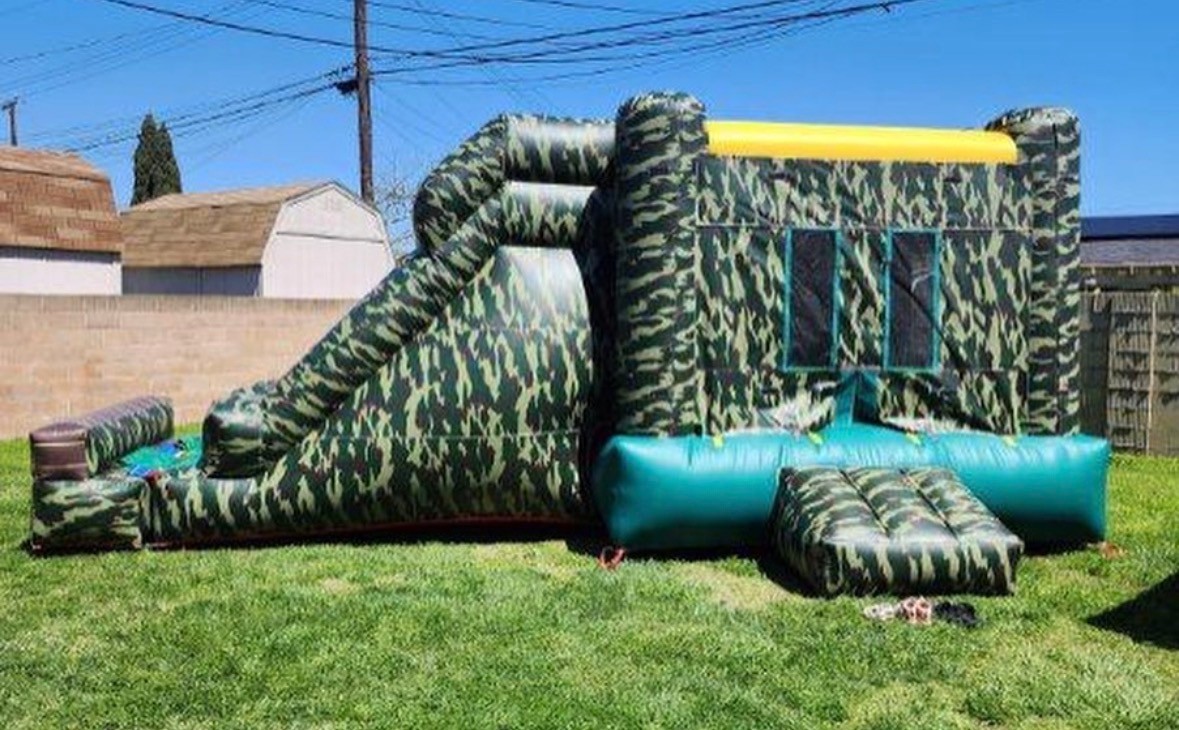
A 16x16 or larger unit, including combo bounce houses that add a slide or climbing wall, can handle eight to twelve kids simultaneously. For a party of 18 to 20 kids, especially if the ages skew older or more energetic, a combo unit in this range keeps the line moving and adds variety so kids stay engaged longer. The tradeoff is footprint: these units need more clearance on all sides, so your yard needs to be measured before you commit.
If you want a deeper look at how to translate those footprint numbers into a booking decision, the how to pick the right bounce house size for your backyard guide walks through the math in plain language.
Matching Unit Type to Your Party Setup
Size is one dimension of the decision, but unit type matters just as much for a 10 to 20 kid party. A standard bounce house, a combo unit, and an obstacle course each serve a different crowd dynamic, and picking the right type can make the difference between a smooth party and a chaotic one.
A standard bounce house is the simplest choice and works well when your guest list skews younger, say ages three to seven. Younger kids do not need a lot of variety to stay happy. They will bounce, fall, laugh, and repeat for an hour without needing a slide or obstacle element. A clean, well-maintained standard unit in the 13x15 to 15x15 range is often the most practical and space-efficient option for a smaller backyard party in this age group.
A combo bounce house adds a slide to the bouncing area, which does two helpful things for your party. First, it gives kids a second activity so they naturally cycle through the unit faster, which reduces line buildup. Second, it tends to hold the attention of slightly older kids (ages six to ten) who might get bored with pure bouncing after 20 minutes. For a mixed-age party of 15 to 20 kids, a combo unit is often the most crowd-pleasing choice. You can compare your options on the rentals page to see what combo configurations are available.
An obstacle course is worth considering if your guest list skews toward older kids or tweens. Obstacle courses create a natural flow of kids moving through the unit from one end to the other, which actually manages crowd control for you. For a party of 15 to 20 kids ages eight and up, an obstacle course can be more effective than a bounce house at keeping everyone engaged and moving. The tradeoff is that obstacle courses need more linear space, so they are better suited to longer, narrower yard configurations.
Backyard Space and Clearance: What OC Yards Typically Offer
Orange County backyards vary a lot depending on the city and neighborhood. A Yorba Linda home on a larger lot might have 40 feet of open grass to work with, while a newer construction home in Irvine or a townhome community in Aliso Viejo might have a much tighter footprint. Knowing what is typical in your area helps you set realistic expectations before you measure.
Most standard OC backyards in single-family neighborhoods offer somewhere between 400 and 800 square feet of usable open space, but that number shrinks quickly once you account for patio furniture, a pool or spa, planters, and the clearance buffer an inflatable needs on all sides. A bounce house needs at least two feet of clearance on every side beyond its stated footprint, and three to four feet is better. That means a 15x15 unit actually needs closer to a 19x19 or 20x20 clear area to set up safely.
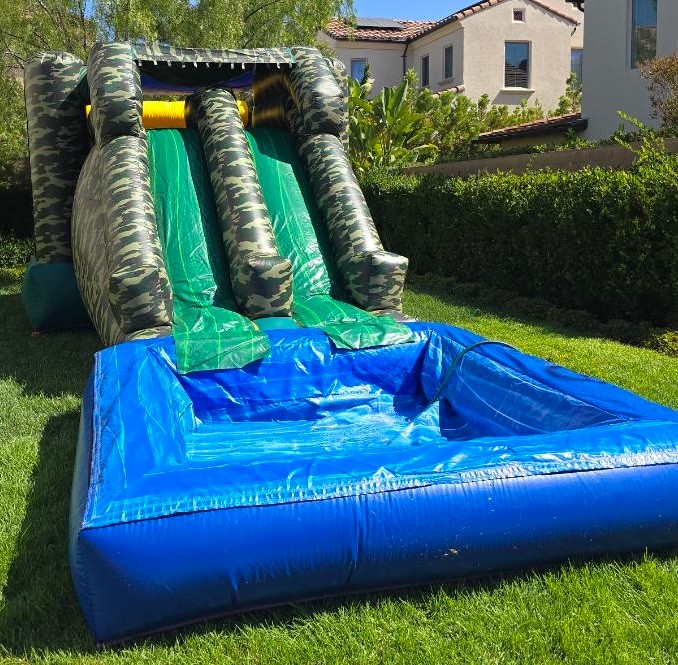
Overhead clearance matters too, especially for combo units with slides or for any inflatable placed near a patio cover, pergola, or tree canopy. Most standard bounce houses stand between 12 and 15 feet tall, and combo units with slides can reach 16 feet or more. A low patio cover or overhanging tree branch can make an otherwise suitable yard unusable for certain units.
Before you book, walk your yard and measure the longest open stretch in both directions. Note any slopes, because even a gentle grade can affect how an inflatable sits and anchors. The prepare your backyard before inflatable rental arrives guide covers exactly what to check so you are not surprised on delivery day. If your yard has a noticeable slope, the sloped backyard guide is also worth a read before you finalize your booking.
How to Confirm You Have the Right Fit Before Booking
Once you have a sense of your guest count, the age range of the kids, and your available yard space, confirming the right unit is a straightforward conversation. The goal is to match all three factors before you finalize anything, not after the truck arrives.
Start by writing down your yard dimensions, including the clear area you measured and the overhead height if there are any obstructions. Then note your expected guest count and the age range of the kids who will be jumping. With those three pieces of information in hand, you can have a productive conversation with the Jump High team about which unit fits your situation. The FAQ page covers common questions about setup requirements, and the contact page is the fastest way to get a direct answer if your yard has anything unusual going on.
One practical tip: if you are genuinely unsure whether your yard can fit the unit you want, err toward the smaller size and add a second activity rather than trying to squeeze a larger unit into a tight space. A 13x15 bounce house plus a lawn game setup will give 15 kids more to do than a 16x16 unit crammed against the fence with no room to breathe.
For parties on the larger end of this range, 18 to 20 kids, it is also worth thinking about whether a single unit is enough. Some families in that range find that two smaller units, or a combo unit paired with a simple activity station, keeps the party flowing better than one large inflatable. The book a bounce house rental in Orange County guide walks through the full booking process so you know what to expect from inquiry to delivery day.
The right size is not always the biggest size available. For a 10 to 20 kid party in an OC backyard, the right size is the one that fits your space comfortably, keeps the line moving without long waits, and leaves enough room for the rest of your party to actually happen around it. That combination is what makes the day feel effortless rather than squeezed.
Ready to find the right size for your crew? Browse Jump High's inflatable options at jumphighrental.com/rentals and reach out to confirm your yard dimensions before you book.