
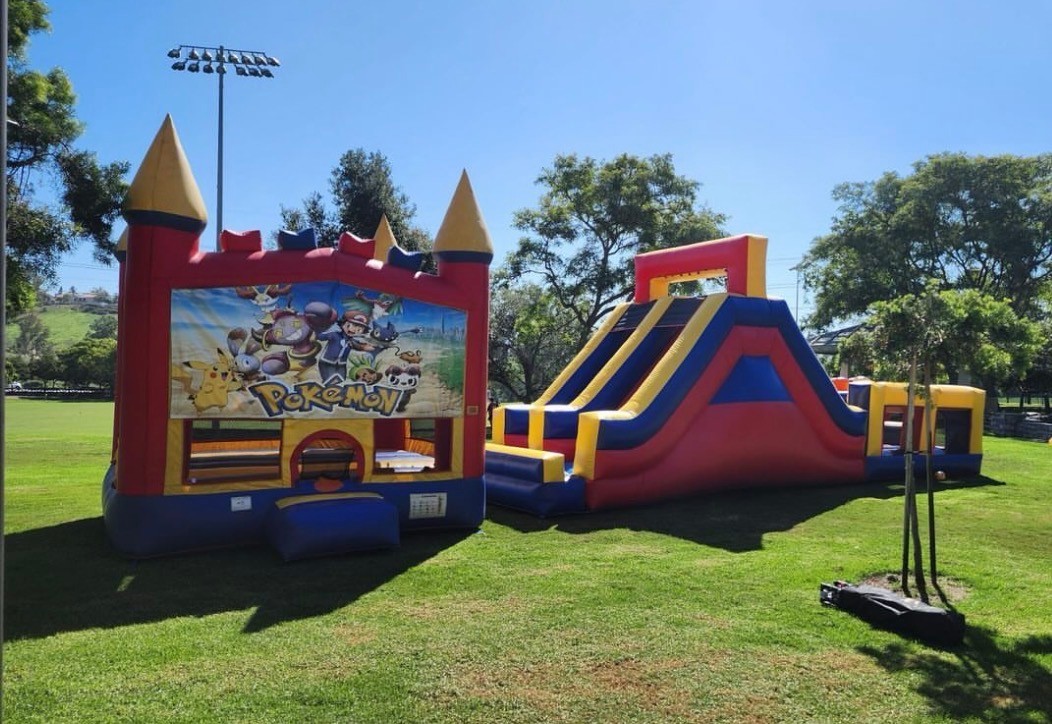
Artificial turf has become a popular backyard choice across California, and it is easy to see why. It stays green year-round, holds up to heavy foot traffic, and skips the mud problem entirely. But when a birthday party or neighborhood event is on the calendar, a common question comes up: can you actually set up a bounce house on synthetic grass?
The short answer is yes, in many cases you can. The longer answer is that artificial turf introduces a few setup considerations that natural grass does not, and knowing those differences before you book will make the whole experience smoother and safer for everyone involved.
Can You Set Up a Bounce House on Artificial Turf?
Artificial turf is a workable surface for inflatable rentals, but it is not automatically the same as a natural grass lawn. The surface itself is usually fine for supporting a bounce house. The more important question is what sits underneath it and whether the site allows the anchoring method your rental company needs to use.
On natural grass, inflatables are typically secured with ground stakes driven directly into the soil. Turf changes that equation. Most synthetic grass installations sit over a compacted base layer, sometimes with drainage components, utility lines, or irrigation systems running underneath. Driving stakes through turf in those conditions can damage the base, the turf backing, or underground infrastructure.
Because of that, reputable rental companies in CA will use weighted anchoring instead of stakes when setting up on artificial turf. Sandbags are the most common solution. Industry guidance points to roughly 40 to 50 pounds per anchor point as a starting baseline, with larger or taller inflatables requiring more weight at each connection. Every tie-down point on the inflatable needs to be secured, not just a few of them. Leaving even one anchor unsecured can create uneven tension across the unit and increase movement during use.
The bottom line: a bounce house can often go on artificial turf, but only when the anchoring method matches the surface and the site allows it. Confirming that before delivery is the most important step you can take.
Why Anchoring on Turf Is Different from Natural Grass
Understanding the anchoring difference helps you have a more productive conversation with your rental company and avoid surprises on the day of your event.
On a natural grass lawn, stakes go into soft soil and hold the inflatable firmly in place with minimal surface disruption. The setup is straightforward and the anchor points are reliable as long as the ground is not too dry or compacted.
Artificial turf requires a different approach for a few reasons:
- The base layer is not soil. Most turf installations use crushed aggregate, decomposed granite, or compacted fill as a base. Stakes do not hold well in these materials and can shift or pull out under load.
- The turf backing can be damaged. Forcing stakes through synthetic grass can tear the backing material, which is costly to repair and may void any warranty on the turf installation.
- Utilities may run underneath. Irrigation lines, drainage pipes, and electrical conduit are sometimes buried just below the surface in residential and commercial turf areas. Staking without knowing what is underneath creates a real hazard.
- Sandbags protect the surface. When weights are placed directly on turf, a padded mat or similar buffer underneath the sandbag can reduce wear on the synthetic fibers and keep the turf looking its best after the event.
Wind behavior does not change just because the surface is artificial. Inflatables should generally be shut down when sustained winds reach 15 to 20 mph, and that guidance applies equally on turf. If gusts pick up during your event, the right move is to clear the unit and wait for conditions to improve, regardless of how well it is anchored.
How to Prepare Your Turf Area Before Delivery
A little preparation before your rental company arrives makes setup faster and reduces the chance of any last-minute complications.
Start by measuring the area where the inflatable will go. The footprint you need is larger than the bounce house itself. You need clearance around all four sides, space for the blower unit (which typically sits outside the inflatable), and a clear entry and exit zone. For obstacle courses and combo units, that extra clearance becomes even more important.
Once you have confirmed the space is large enough, walk the area and clear it completely. Remove patio furniture, sports equipment, garden hoses, toys, and anything else that could get in the way during setup or create a tripping hazard near the inflatable. Check for any utility covers, irrigation heads, or drainage grates that might be hidden in the turf and flag those for your delivery team.
Think about access as well. Your rental company will need to move equipment from the delivery vehicle to the setup area. A clear, wide path through a gate or side yard makes that process much easier and protects your turf from unnecessary wear during the move-in.
If you know the type of turf you have, share that information when you book. Decorative landscape turf, playground turf, and sports-field turf each have slightly different base constructions, and that can affect which anchoring approach works best for your specific setup.
Venue and HOA Approval: What to Confirm First
If your turf is in a shared space, a community park, a school field, or a property governed by an HOA, getting approval before you book is not optional. It is the step that prevents a delivery day cancellation.
Property managers, HOA boards, school administrators, and venue coordinators often have specific rules about what can be placed on their turf and how it must be anchored. Some venues prohibit stakes entirely. Others have restrictions on sandbag weight, power cord routing, or access routes for delivery vehicles. A few may require proof of insurance from the rental company before they allow setup.
The safest approach is to contact the property manager or venue coordinator directly and ask these specific questions:
- Are inflatables permitted on this turf surface?
- Is staking prohibited, and if so, are weighted anchors (sandbags) allowed?
- Are there any restrictions on where power cords can run or how the blower must be positioned?
- What is the approved access route for delivery equipment?
- Is there a minimum notice period or a permit required for this type of setup?
Getting written confirmation of the answers is worth the extra step. It protects you if questions come up on the day of the event and gives your rental company the information they need to plan the right setup.
For backyard turf that is entirely on your own private property, the approval process is simpler, but it is still worth checking whether your HOA has any rules about temporary structures or commercial deliveries before your event date.
Questions to Ask Your Rental Company About Turf Setups
Not every rental company handles artificial turf the same way, and the right questions upfront will help you choose a provider who is prepared for your specific setup.
Before you confirm a booking, ask your rental company:
- Do you have experience setting up on artificial turf in CA?
- Will you use sandbags or weighted anchors instead of stakes on my surface?
- How much weight do you use per anchor point, and does that change for larger units?
- Do you bring surface protection (such as padded mats) to place under the sandbags?
- What information do you need from me about my turf type and the setup area?
- Are there any inflatable sizes or styles that are not recommended for weighted-only anchoring?
A rental company that has worked on turf setups regularly will have straightforward answers to all of these. If a company is unfamiliar with the anchoring differences or cannot explain their approach, that is worth noting before you commit.
At Jump High Rentals, we are happy to talk through your turf setup before you book. Describe your space, the type of turf you have, and the size of the unit you are considering, and we can help you figure out whether the setup is a good fit and what the delivery day will look like. Reach out before your event date so we have time to plan the right approach for your specific backyard or venue.
Artificial turf should not be a reason to skip the bounce house. With the right anchoring method, a cleared setup area, and a quick check on any venue rules, it can be a perfectly safe and practical surface for a great Orange County party.