
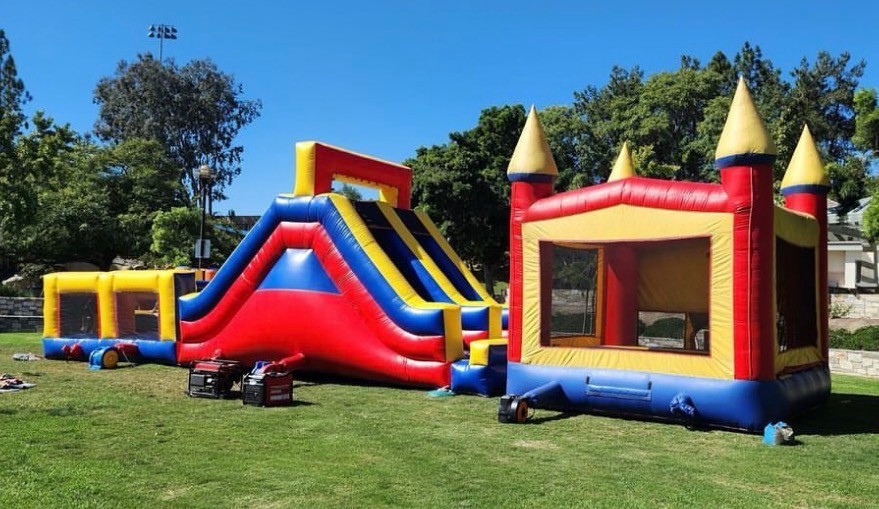
Planning a party or community event for around 100 guests is exciting, and it is also the point where most organizers start second-guessing their inflatable order. Should you book one big unit or three smaller ones? Is a bounce house enough, or do you need a slide and an obstacle course too? The honest answer depends on factors that go well beyond headcount, and this guide walks through all of them so you can build a lineup that actually works on the day of your event.
Why Guest Count Alone Does Not Tell You How Many Inflatables You Need
Here is the most common mistake event planners make: they hear "100 guests" and immediately try to calculate how many people can fit inside an inflatable at once. That math leads to overbooking or, worse, a single oversized unit that creates a bottleneck.
The real question is not how many guests you have. It is how many guests will be using the inflatables at any given moment, and how quickly they rotate through.
Think about a typical school carnival or church family night. Out of 100 attendees, a meaningful portion are adults who are there to supervise, socialize, or eat. Of the children who do want to bounce, they are not all lining up at the same second. They drift in and out between food, games, and other activities. That natural flow changes your capacity math entirely.
A few questions worth answering before you even look at inflatable options:
- How many of your 100 guests are children versus adults?
- How long is the event, and will kids cycle through multiple times?
- Is this a backyard birthday, a school carnival, a church picnic, or an HOA block party?
- Do you want one type of activity or a mix of bouncing, sliding, and obstacle play?
Once you have those answers, the numbers start to make a lot more sense.
Throughput by Inflatable Type: Bounce Houses, Combos, Slides, and Obstacle Courses
Not all inflatables move guests at the same rate. Understanding throughput, meaning how many people can realistically use a unit per hour, is the most useful planning tool you have.
Here is a practical breakdown based on typical industry benchmarks:
- Standard bounce houses move roughly 50 to 60 people per hour. They are great for younger kids at smaller gatherings, but they create lines quickly at larger events.
- Combo bounce houses (units with a bounce area plus an attached slide) handle closer to 60 to 80 people per hour. The added slide element speeds up turnover because kids have a clear entry and exit path.
- Inflatable slides on their own can move about 180 to 220 people per hour. Because the experience is quick, riders go up, slide down, and move on, throughput stays high even at busy events.
- Obstacle courses are the highest-capacity option, handling roughly 220 to 260 people per hour. They work especially well for school events and community gatherings where you want kids engaged and moving rather than waiting.
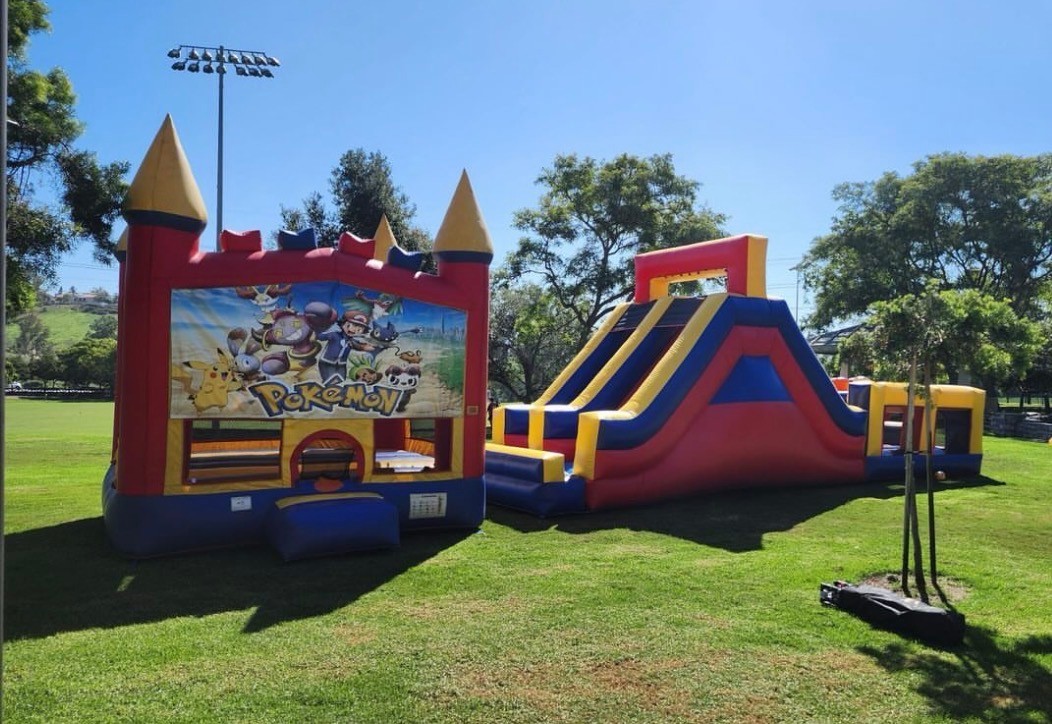
What this means practically: if your 100-guest event skews heavily toward active kids and you only book one standard bounce house, you will have a line within the first 30 minutes. Adding a combo unit or swapping in an obstacle course changes that picture significantly.
How Many Inflatables for 100 Guests: A Practical Range by Event Type
There is no single right answer, but there is a useful planning range depending on what kind of event you are hosting.
Backyard birthday party (100 guests, mixed ages): One to two inflatables is usually enough. In a backyard setting, not everyone is using the equipment at once, and the event has a natural rhythm of cake, presents, and food that breaks up inflatable time. A combo bounce house or a standalone slide paired with a smaller bounce house covers most age groups well.
School carnival or church family event (100 guests, mostly children): Three to four inflatables is a safer starting point. Larger groups of kids create lines fast, and having multiple units keeps energy up without frustration. A good mix might include one obstacle course for older kids, one combo bounce house for the middle age group, and one toddler-friendly unit if younger children are attending.
HOA block party or community event (100 or more guests, all ages): Four to five inflatables, or two to three high-throughput units like obstacle courses and slides, tends to work better than relying on bounce houses alone. Community events often run longer and draw guests in waves, so having variety keeps people coming back to the inflatable area throughout the afternoon.
One important note: these ranges assume you have the space to support multiple units. If your venue is tight, one well-chosen high-throughput unit will outperform two smaller ones that are crowded together.
Space, Permits, and Setup Realities for CA Events
Knowing how many inflatables you want is only part of the planning. You also need to confirm that your venue can physically support them and that you have handled any required approvals.
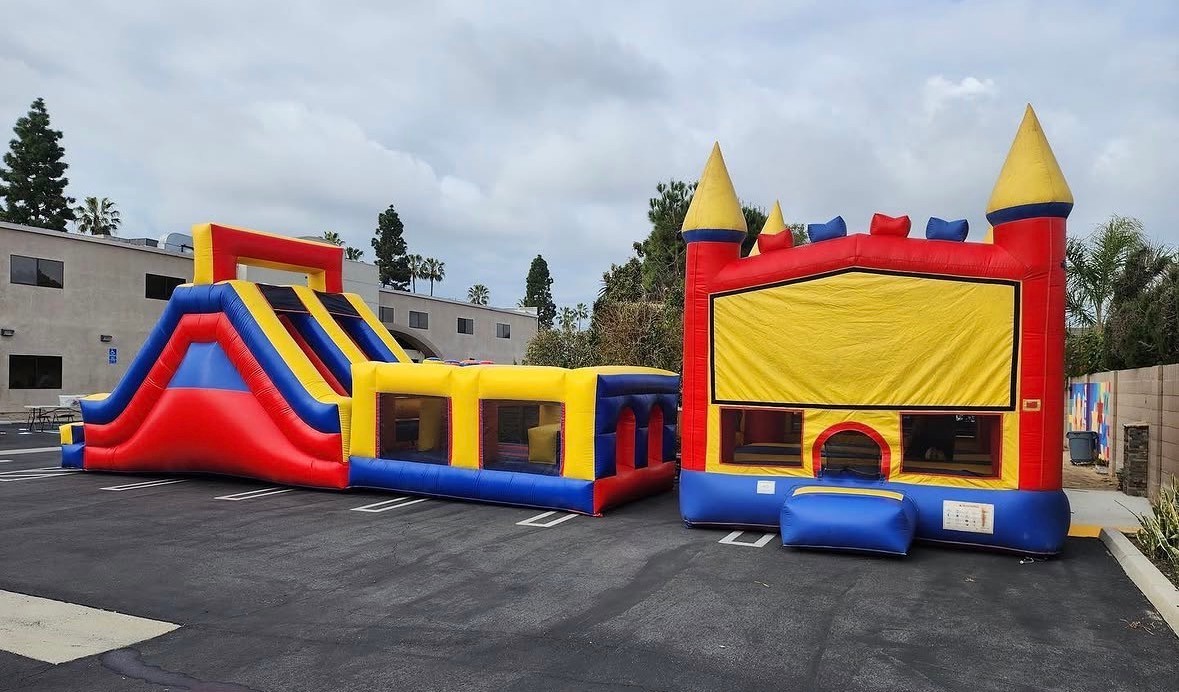
Space requirements vary by unit. A typical water slide needs roughly 36 feet by 15 feet of flat, clear space. A combo bounce house may need closer to 34 feet by 18 feet. Obstacle courses are longer and require even more linear space. Before you finalize your order, measure your venue and share those dimensions with your rental company so they can recommend units that actually fit.
Park events in California often require permits. If you are hosting at a public park in Orange County, cities including Irvine, Anaheim, Mission Viejo, and others have their own permit processes for inflatables and amplified sound. Lead time matters here. Some permits require several weeks of advance notice, and approval is not guaranteed. Check with your local parks department well before your event date. Jump High Rentals can share general guidance on what to expect, but permit decisions rest with the city or park authority.
Delivery and setup logistics matter for large orders. Multiple inflatables mean multiple setup windows. A good rental company will coordinate arrival times so that everything is ready before your guests arrive, but you should confirm the setup timeline when you book. For events with three or more units, plan for at least 90 minutes of setup time, and make sure the delivery crew has clear vehicle access to the setup area.
Power access is a real constraint. Each inflatable runs on a blower that draws consistent power. For multiple units, you may need multiple dedicated circuits or a generator. Ask your rental company what power requirements each unit carries and plan accordingly before the day of the event.
How to Build Your Inflatable Lineup Before You Book
Once you understand throughput, space, and event type, building your lineup becomes much more straightforward. Here is a simple process that works well for most Orange County events.
Start with your guest profile. Count how many children will actually be using the inflatables and estimate the age range. Toddlers and big kids do not mix well in the same bounce house, so if you have both, plan for at least two separate units.
Then match your throughput needs to your event length. If your event runs four hours and you expect 60 kids to rotate through, a combo bounce house handles that comfortably on its own. If you expect 80 kids in a two-hour window, you need either a second unit or a higher-throughput option like an obstacle course.
Next, confirm your space. Measure the setup area, note any slopes or obstacles, and check for overhead clearance. Share all of that with your rental company before finalizing your order.
Finally, think about variety. A mix of activity types, bouncing, sliding, and obstacle play, keeps kids engaged longer and naturally distributes the crowd across multiple units. That reduces wait times and keeps the energy positive throughout the event.
If you are planning a 100-guest event in Orange County and want a straightforward recommendation based on your specific venue, guest mix, and available space, reach out to Jump High Rentals. There is no pressure and no complicated process. Just share the details of your event and the team can help you put together a lineup that fits your space, your crowd, and your budget.