
Combo Bounce Houses for OC Rental Fleets in 2026
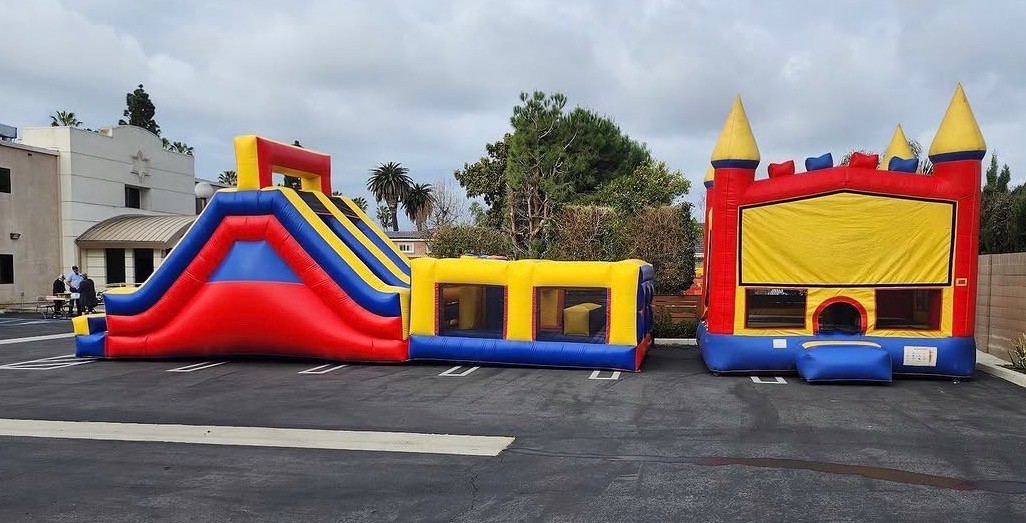
If you're building or expanding a rental fleet in Orange County, combo bounce houses deserve a serious look as a core inventory investment. A combo unit combines a bounce chamber with a slide, obstacle elements, or both, which means a single inflatable can serve toddlers, grade-schoolers, and tweens at the same event. That versatility translates directly into more bookings per year, stronger utilization rates, and a faster path to recouping your purchase cost. This guide walks through the strategic case for combo units, what to look for in commercial-grade specs, how freight and storage work in the OC market, and how the numbers stack up against single-feature inflatables.
Why Combo Units Earn More Bookings Per Year in OC
Orange County's party rental market is competitive, and customers shopping for inflatables are increasingly looking for one unit that does more. A parent hosting a birthday party with kids ranging from age four to twelve does not want to rent a toddler bounce house and a separate slide. A combo unit solves that problem in a single booking, which makes your listing easier to say yes to.
From a fleet operator's perspective, that broader appeal matters a lot. A standalone bounce house tends to attract bookings from parents of younger children, typically ages three to eight. A standalone waterslide skews older and seasonal. A combo unit with a bounce chamber and an attached slide captures both audiences, and it stays relevant across spring birthdays, summer pool-adjacent setups, fall school carnivals, and church events year-round. You can explore how combo rentals perform across OC event types to get a sense of the demand patterns your customers are navigating.
Higher booking frequency also reduces the pressure on any single unit to carry your revenue. When a combo inflatable books 30 to 40 weekends per year instead of 18 to 22 for a more specialized unit, your cost-per-booking drops significantly. In a market like Orange County, where summer weekends fill up fast and fall events extend the season, that utilization difference compounds quickly.
There is also a practical upsell angle. Customers who book a combo unit often add tables, chairs, or a generator to their order, which increases your average transaction value without requiring you to stock more inflatables. A well-chosen combo unit becomes an anchor product that lifts the rest of your catalog.
Specs and Sizing: What to Look for in a Commercial Combo Inflatable
Not all combo units are built for commercial rental use. Consumer-grade inflatables sold at big-box retailers use lighter vinyl and lower-capacity blowers, and they will not hold up to the weekly setup and teardown cycles that a rental fleet demands. When you are evaluating commercial combo units for purchase, the spec sheet matters as much as the price tag.
Start with the material weight. Commercial-grade combo inflatables are typically constructed from 18-ounce PVC-coated nylon or similar heavy-duty vinyl. Anything lighter than 15-ounce material is a warning sign for a unit intended for repeated rental use. Reinforced stitching at stress points, including the slide seams, anchor loops, and entrance arch, is a non-negotiable feature. Ask manufacturers for their stitch count and seam overlap specifications before committing.
Blower compatibility is another critical spec. Most commercial combo units in the 15-by-15-foot to 20-by-20-foot range require a 1.5 HP to 2 HP continuous-duty blower. Confirm that the unit ships with a compatible blower or that the manufacturer specifies which third-party blowers are rated for the unit. Undersized blowers cause premature wear on the vinyl and create safety issues during use. You can review power and extension cord requirements for OC inflatables to understand what your customers will need on-site, which also informs how you brief them at booking.
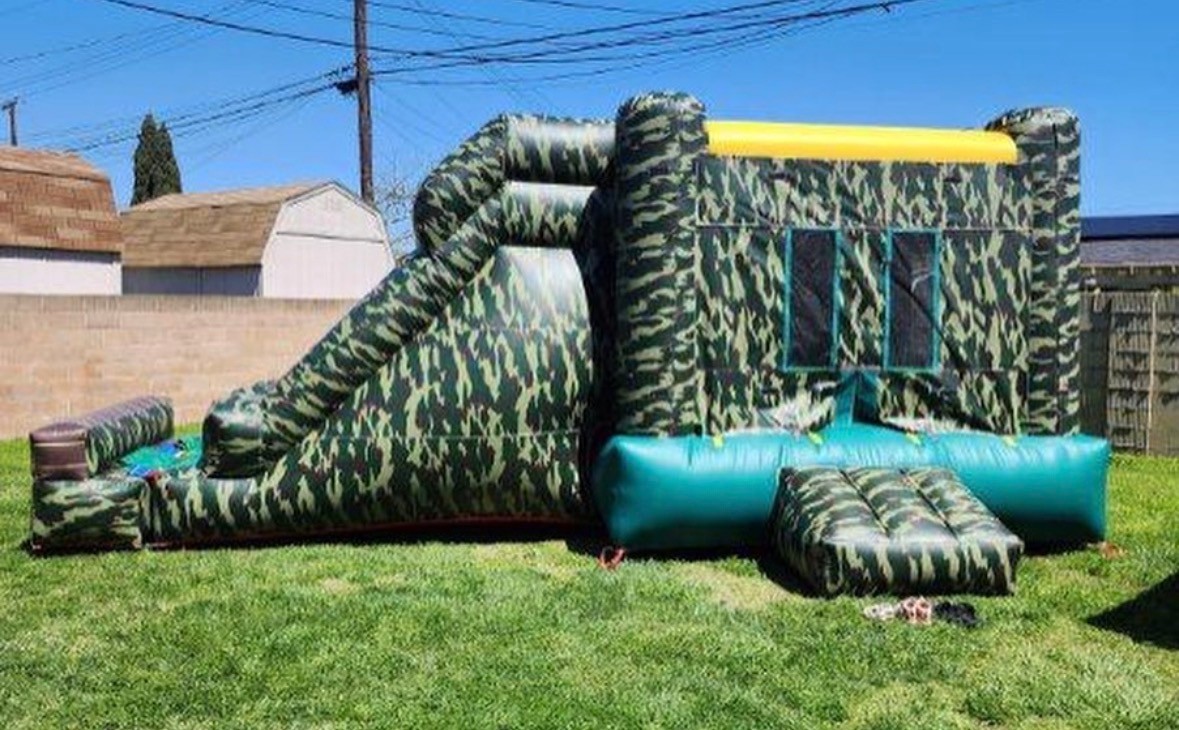
Footprint and capacity ratings are especially important for OC backyards, which tend to run smaller than properties in less dense markets. A combo unit in the 15-by-20-foot range with a 10-foot slide height is a practical sweet spot for most Orange County residential setups. It fits through a standard side gate with proper deflation and rolling technique, and it leaves enough clearance for anchoring on a typical 40-by-60-foot backyard lawn. Units larger than 20 by 25 feet will limit your bookable addresses significantly, so weigh the visual appeal of a larger unit against the number of OC homes that can actually accommodate it.
Manufacturer-rated capacity for mixed-age use should be clearly stated in the documentation. Look for units rated for at least eight to ten simultaneous users in the bounce chamber, with a separate slide lane that accommodates one rider at a time. Units that try to combine the slide exit zone with the bounce floor create congestion and increase the likelihood of collisions, which is a customer complaint you want to avoid entirely.
Freight, Delivery, and Storage Considerations for OC Fleet Operators
Purchasing commercial inflatables involves freight costs that can add meaningfully to your per-unit acquisition price. Most major inflatable manufacturers ship from facilities in California, Texas, or directly from overseas factories in China. A California-based manufacturer or distributor will typically offer lower freight costs and faster lead times for OC buyers, which matters when you are trying to get a new unit into rotation before a peak booking window.
For a standard commercial combo unit weighing 200 to 350 pounds, freight from a domestic distributor to an Orange County address generally runs in the range of $150 to $400 depending on carrier, shipping class, and whether you have a loading dock or need a liftgate delivery. Overseas direct orders can reduce the unit cost by 20 to 40 percent, but they add 6 to 12 weeks of lead time, import duties, and the risk of quality variance between production runs. If you are ordering your first combo unit, a domestic distributor with a return or warranty claim process is usually the safer starting point.
Storage is a real cost that fleet operators sometimes underestimate. A deflated and rolled combo unit in the 15-by-20-foot range typically packs down to a bundle roughly 4 by 4 by 3 feet, weighing 200 to 300 pounds. You will need a dry, climate-controlled storage space to prevent mold and vinyl degradation. Orange County's coastal humidity, particularly in cities closer to the coast like Huntington Beach or Newport Beach, can accelerate mildew growth on improperly stored vinyl. A dehumidified garage or small warehouse unit is a worthwhile operating expense.
Delivery logistics for your customers also factor into your operational planning. Combo units with attached slides require more careful transport than flat bounce houses, since the slide structure adds height and awkward geometry to the rolled bundle. A cargo van or enclosed trailer with tie-down points is the standard setup for OC fleet operators running one to five units. As your fleet grows, a box truck with a liftgate becomes a practical investment that protects your equipment and reduces setup crew fatigue.
ROI Breakdown: Combo Units vs. Single-Feature Inflatables
The financial case for combo units rests on three variables: purchase price, rental rate, and annual bookings. In the 2026 OC market, a commercial-grade combo bounce house with slide typically retails from a domestic distributor in the $2,500 to $4,500 range, depending on size, theme, and included accessories. A comparable standalone bounce house runs $1,200 to $2,200, and a standalone waterslide runs $2,000 to $3,500.
On the revenue side, combo units in Orange County typically command rental rates of $250 to $400 for a four-hour booking, compared to $175 to $275 for a standalone bounce house. That rate premium reflects the added features and the broader audience appeal. If a combo unit books 35 weekends per year at an average rate of $300, it generates $10,500 in gross revenue. A standalone bounce house booking 22 weekends at $225 generates $4,950. The combo unit's higher acquisition cost is offset within the first season in most scenarios, assuming reasonable utilization.
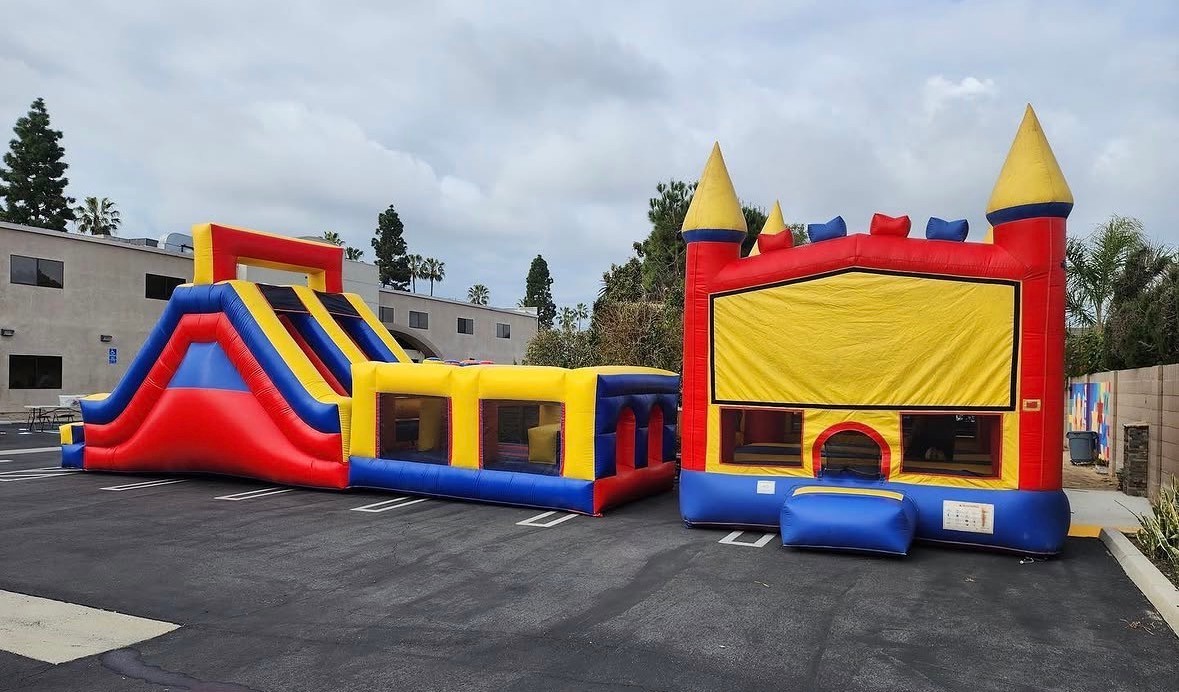
Depreciation is worth factoring in as well. A well-maintained commercial combo unit has a useful life of five to eight years with proper cleaning, storage, and periodic repair. Spreading a $3,500 acquisition cost over six years yields roughly $583 per year in depreciation, which is a manageable line item against $10,000-plus in annual gross revenue. The inflatable rental checklist for OC parties with 50 guests gives you a useful reference for the event scale where combo units consistently outperform single-feature inflatables in customer satisfaction.
Single-feature inflatables still have a place in a balanced fleet. A toddler-specific bounce house or a high-capacity waterslide fills niches that a combo unit does not fully cover. But if you are choosing your first or second commercial unit and want the broadest possible booking appeal in the OC market, a combo inflatable is the stronger strategic choice.
Warranties, Vendor Support, and Sourcing for Wholesale Buyers
Commercial inflatable warranties vary widely, and the fine print matters more than the headline coverage period. A reputable manufacturer will offer at least a one-year warranty on seams and stitching, with separate coverage for the blower motor. Some domestic manufacturers offer two to three year structural warranties on commercial units, which is worth paying a modest premium for when you are making a $3,000-plus purchase.
Before you commit to a vendor, ask specifically about the warranty claims process. A warranty that requires you to ship the unit back to the factory for inspection is far less useful than one that allows you to submit photos and receive a repair kit or replacement panel by mail. For an OC-based operator running weekend bookings, a unit that is out of service for three to four weeks waiting on a warranty repair represents real lost revenue.
Vendor support also includes access to replacement parts. Confirm that your chosen manufacturer stocks replacement blowers, repair patches, and anchor stakes for your specific unit model. Generic repair patches work for minor punctures, but slide panels and entrance arches are unit-specific and can be difficult to source from third parties.
For wholesale sourcing, domestic distributors with California warehouse locations offer the fastest turnaround and the easiest returns process. Industry trade shows, including those organized by the Amusement Industry Manufacturers and Suppliers International (AIMS), are a practical way to evaluate multiple vendors in person, compare build quality side by side, and negotiate volume pricing if you are planning to purchase two or more units.
If you want to see how combo units perform in real OC rental scenarios before committing to a purchase, browsing the Jump High Rentals catalog gives you a ground-level view of which units are actually booking in this market. You can also reach out through the contact page to discuss inventory planning questions specific to Orange County event demand, seasonal patterns, and which unit configurations tend to generate the most repeat bookings from local customers.
Building a rental fleet in Orange County is a long-game investment, and the units you choose in year one shape your booking volume for years to come. Combo bounce houses offer the versatility, utilization rates, and revenue potential that make them a smart anchor product for any OC fleet operator looking to grow in 2026 and beyond.