
Which Surfaces Work for Bounce House Setup in CA
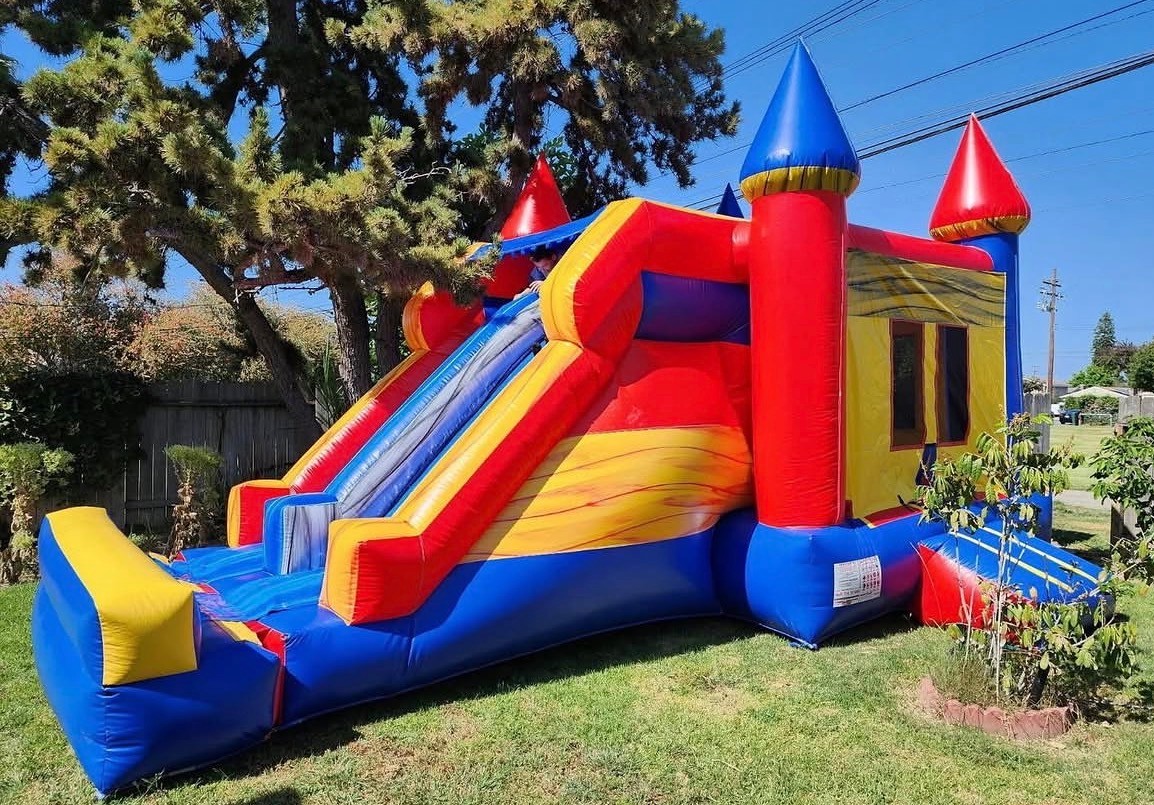
One of the most common questions parents ask before booking is simple: "Can a bounce house actually go in my backyard?" The honest answer is that most Orange County yards work just fine, as long as you know what your surface requires and share those details with your rental company ahead of time. Grass, concrete, pavers, and artificial turf can all support a safe setup when the right anchoring method is used for each one.
Flat natural grass is the easiest surface to work with, and it remains the most common setup location for backyard birthdays across Orange County. Grass provides natural cushioning beneath the inflatable, and it accepts steel ground stakes cleanly, which gives the unit a firm, stable anchor. Before the crew arrives, take a few minutes to walk the area and clear out any rocks, toys, sprinkler heads, or debris. A clean, flat patch of grass with good drainage sets the crew up for a fast, smooth installation.
Concrete, asphalt, and paved surfaces are also fully workable, and many OC homes have side yards, driveways, or patio areas that fit a bounce house nicely. The key difference is that stakes cannot go into hard surfaces, so the unit is secured with heavy sandbags or weight anchors placed at each anchor point. When properly weighted, the inflatable sits just as securely as it would on staked grass. If you have a large concrete patio or a wide driveway, it is worth measuring the space and sharing those dimensions when you contact Jump High Rentals, because some combo units and obstacle courses need more room than a standard bounce house.
Artificial turf has become increasingly common in Southern California backyards, and it is a perfectly acceptable surface for inflatable rentals with one important note. Stakes can damage the turf backing, so weight anchors are used here as well. You will also want to confirm that the turf is installed over a firm, level base rather than loose fill or soft foam padding that could shift under the weight of the unit. Our guide to bounce houses on artificial turf in CA covers this in more detail if your yard uses synthetic grass.
How Anchoring Changes by Surface Type
Anchoring is the part of setup that most parents never see, but it is one of the most important safety steps in the entire process. A properly anchored inflatable stays put even when kids are bouncing at full energy and even when an afternoon breeze picks up. The method your crew uses depends entirely on what is underneath the unit.
On grass, steel ground stakes are driven into the soil at each corner and along the sides of the inflatable. The stakes connect to anchor straps sewn into the unit itself. This system is fast to install and extremely reliable when the ground is firm and the soil is not waterlogged or sandy. If your yard has very soft or recently watered soil, let the crew know so they can assess whether additional anchoring is needed.
On concrete, asphalt, or pavers, sandbags or ballast weights replace the stakes entirely. Each bag is placed directly on the anchor strap loops, and the combined weight holds the unit down against wind and movement. The weight requirement varies by unit size, so a larger obstacle course or combo waterslide needs more ballast than a standard bounce house. Your rental company should arrive with the correct weight for the specific unit you booked. If you are curious about how this works in practice, the bounce house anchoring and staking setup guide walks through the process step by step.
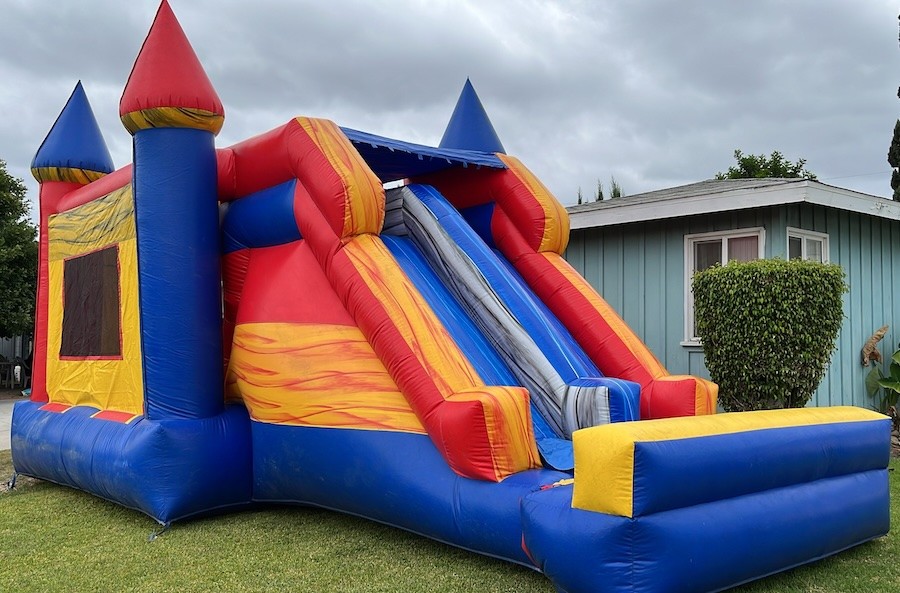
Artificial turf setups use the same sandbag approach as concrete, but the crew will also take care not to drag equipment across the turf surface during setup and teardown. Letting the crew know in advance that your yard is artificial turf helps them bring the right materials and plan their approach before they arrive.
Wind is a factor on every surface. California afternoons can bring unexpected gusts, particularly in hillside neighborhoods and coastal areas of Orange County. Most inflatables have a wind speed threshold, typically around 20 to 25 miles per hour, at which point the unit should be deflated for safety. Jump High monitors weather on event days and will work with you if conditions require a change of plans. You can read more about how wind affects inflatable safety in the wind speed limits and inflatable safety guide for OC parties.
Surfaces and Situations to Avoid
Not every yard or venue is the right fit for a bounce house, and knowing the situations to avoid ahead of time saves everyone a stressful morning on delivery day. The most important rule is that the setup surface must be flat. A slope of even a few degrees can cause the inflatable to shift during use, which creates a real safety risk for kids inside.
Gravel and loose rock surfaces are not suitable for bounce house setup. Loose material shifts under the weight of the unit, stakes do not hold reliably in gravel, and the texture itself can damage the inflatable's base. If your yard has a gravel section, check whether there is an adjacent grass or paved area that would work instead.
Uneven terrain, including areas with visible dips, mounds, or tree roots beneath the surface, should be avoided even if the overall yard looks flat. A crew member will assess the setup area on arrival, but if you already know your yard has an uneven patch, it is better to flag it early so you can identify an alternative spot together.
Proximity to pools, ponds, or other water features is another situation that requires extra attention. The inflatable itself should not be positioned directly adjacent to open water. Kids exit bounce houses quickly and in unpredictable directions, so keeping a clear buffer between the unit and any pool edge is an important safety practice. If your event involves both a pool and an inflatable, talk through the layout with your rental company during booking.
Slopes deserve their own mention because they come up often in hillside neighborhoods across Orange County, Yorba Linda, and Anaheim Hills. If your backyard has a noticeable grade, it may still be workable depending on the specific slope and the unit size, but it requires an honest conversation before booking. The sloped backyard guide for inflatable rentals is a helpful starting point if you are unsure about your yard's grade.
Space, Clearance, and Power Requirements
Surface type is only part of the picture. The area around the inflatable matters just as much as the surface underneath it. A standard bounce house needs at least three to five feet of clear space on all sides, and that clearance should be free of fences, furniture, trees, and overhead obstructions. Combo units, obstacle courses, and waterslides typically need more room, so always check the specific dimensions for the unit you are considering before assuming your space will work.
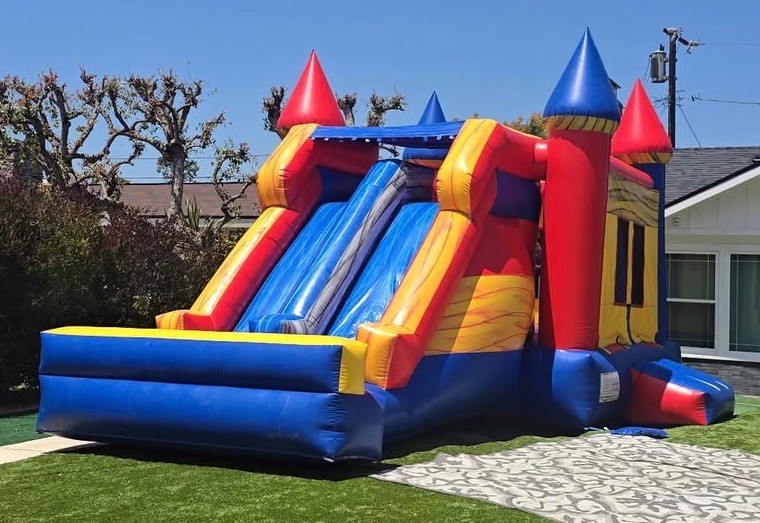
Overhead clearance is easy to overlook. Patio covers, pergolas, low-hanging branches, and power lines can all interfere with setup or create a hazard during use. Measure the height of any overhead structures in your intended setup area and compare that to the inflatable's height before booking. Most standard bounce houses stand between 12 and 15 feet tall, while some combo units and slides reach higher.
Power is the other practical requirement. The blower motor that keeps the inflatable inflated runs continuously throughout your rental, and it needs a standard electrical outlet within 50 to 75 feet of the setup location. A heavy-duty extension cord can bridge the gap if the outlet is not immediately adjacent, but the cord must be rated for outdoor use and routed safely so guests do not trip over it. The power and extension cord guide for OC inflatables covers cord ratings and placement in more detail.
If you are planning a park event rather than a backyard party, most Orange County public parks do not have accessible power outlets near picnic areas. A generator is the standard solution, and Jump High can arrange one for an additional fee. Park events also require a permit from the relevant agency. OC Regional Parks currently charges $75 for this permit, and most cities recommend applying at least two weeks before your event date. The guide to getting a bounce house permit for an OC park event has the details you need if you are going the park route.
What to Tell Your Rental Company Before Delivery
The more your rental company knows about your setup location before delivery day, the smoother everything goes. A few simple details shared at booking can prevent last-minute surprises and make sure the crew arrives with exactly the right equipment.
Start with your surface type. Let the team know whether you have grass, concrete, pavers, or artificial turf, and mention if any part of the area is sloped or uneven. Follow that with your available dimensions, including both the open area for the inflatable and the path the crew will use to bring equipment from the street or driveway to the setup spot. A narrow side gate or a long carry distance through the house is worth mentioning early.
Share your power situation as well. If your nearest outdoor outlet is far from the setup area, or if you are planning a park event where no outlet exists, the crew can plan accordingly. Finally, mention any nearby water features, overhead structures, or other site-specific details that might affect placement.
When you reach out to Jump High Rentals to confirm your booking, the team will review your surface and space details and confirm that your chosen unit is a good fit before anything is finalized. If you are still in the early planning stages and want to browse what is available, the full rentals catalog shows current units with dimensions included. And if you have questions that are not covered here, the FAQ page is a good next stop before you call or message.
A little preparation on the surface and space side of things goes a long way toward making delivery day feel effortless. Most Orange County backyards work beautifully with the right unit and the right anchoring approach. The goal is simply to confirm the details early so the crew can focus on setup and you can focus on the party.