
Booking a bounce house for your child's birthday or a neighborhood block party is one of the easiest ways to keep kids entertained for hours. But if you have ever glanced at a weather app the morning of your event and wondered whether the wind reading matters, you are asking exactly the right question. Wind is one of the most overlooked safety factors in inflatable rentals, and in Orange County it deserves a little extra attention.
This guide gives you a clear, practical answer to the wind question, with local context for the kinds of locations where OC parties actually happen.
What Wind Speed Is Too High for a Bounce House?
The most widely cited industry guidance puts the stop-use threshold at 15 to 20 mph for sustained winds and 25 mph for gusts. The Consumer Product Safety Commission (CPSC) echoes this general range and advises parents not to use a bounce house when it is windy outside, pointing to that 15 to 25 mph window depending on the unit and conditions.
A few important details to keep in mind:
- Sustained wind and gusts are two different measurements. A calm-looking afternoon can still produce short bursts well above 25 mph, especially near the coast or on a hillside.
- Manufacturer specifications can vary. Some inflatables are engineered around a 15 mph sustained limit, while others may be rated slightly higher based on their anchoring design and size.
- The exact limit for the unit you rent should come from your rental company or the equipment label, not a general rule you found online.
- Research on inflatable incidents has found that some accidents occurred in winds below formal thresholds. That is why wind safety is best treated as a dynamic, ongoing check rather than a single number you clear once and forget.
The practical takeaway for parents: check the forecast before setup, keep an eye on real-time conditions throughout the event, and be ready to deflate early if gusts start climbing. A bounce house that is still standing is not automatically a safe one if the wind is picking up around it.
Why OC Locations Change the Wind Equation
Orange County is not one uniform weather zone. A backyard party in Irvine on a warm Saturday afternoon can feel completely different from a school carnival on an open field in Huntington Beach or a hillside HOA event in Laguna Hills. The geography matters.
Coastal areas like Newport Beach, Huntington Beach, and Dana Point tend to see stronger and more consistent afternoon sea breezes. What starts as a mild 10 mph breeze at noon can push past 20 mph by mid-afternoon as the marine layer shifts. If your event runs from 1 to 5 p.m., the windiest stretch of the day often falls right in the middle of your party.
Hillside and canyon-adjacent neighborhoods, including parts of Mission Viejo, Lake Forest, and Foothill Ranch, can experience localized gusts that move through quickly and unpredictably. These are not always captured well by general weather apps, which pull data from the nearest official station rather than your specific backyard.
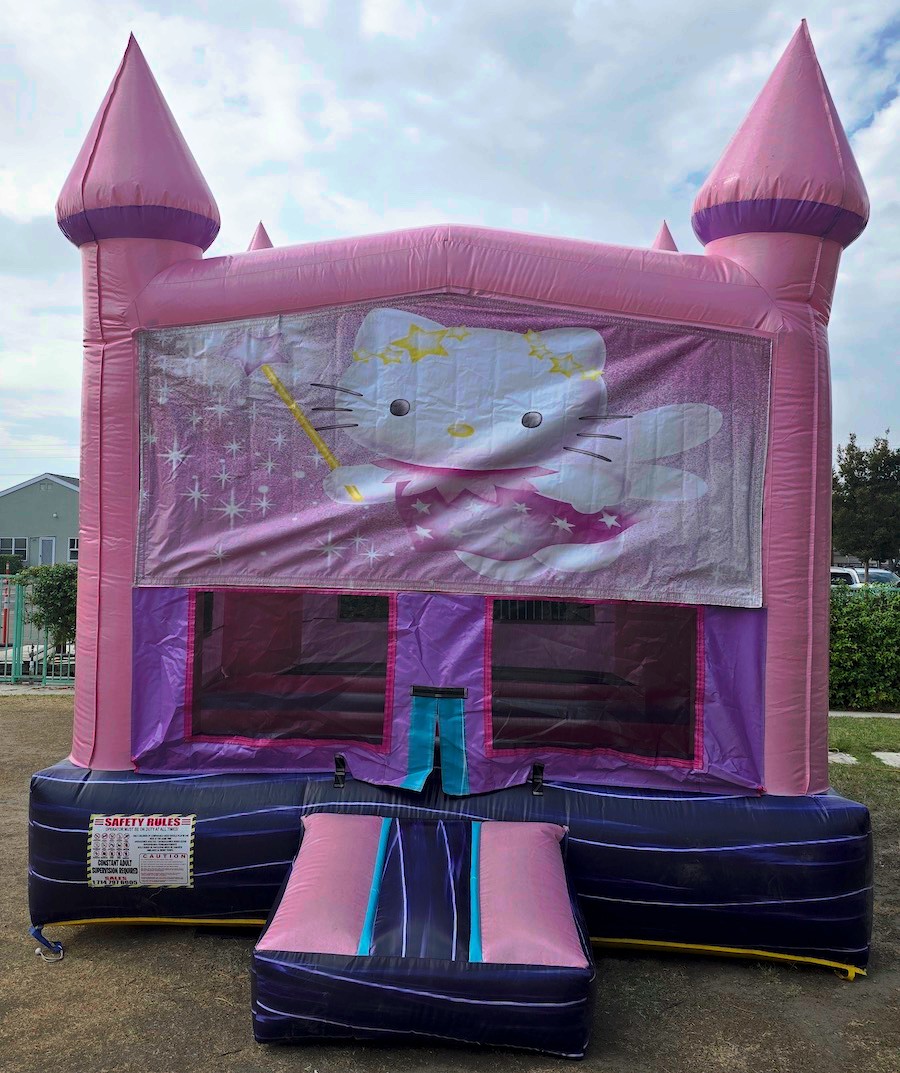
Open fields used for school events, church carnivals, and HOA gatherings present a different challenge. Without fences, trees, or structures to break the wind, inflatables on open ground are more exposed than those set up in a sheltered backyard. A unit that would be fine in a walled residential yard may need earlier supervision or shutdown in an open park setting.
For any of these locations, the smart move is to check a hyperlocal forecast the night before and again the morning of your event, and to assign one adult the specific job of monitoring conditions during the party.
Warning Signs to Watch During Your Party
Wind speed numbers are useful, but your eyes are just as important. Even if the forecast looked fine when you booked, conditions can change on the day of the event. Here are the signs that mean it is time to clear the inflatable and deflate:
- The bounce house starts to lean or tilt to one side
- Any part of the unit lifts off the ground, even briefly
- Anchor stakes appear to be pulling loose or shifting
- The inflatable sags or loses its shape in a way that looks different from normal use
- Kids inside are being pushed or knocked around by the movement of the unit rather than their own jumping
You do not need to wait for a formal wind reading to act on any of these signs. If the unit looks or feels unstable, clear the children out immediately and deflate. Waiting to see if it settles down is not worth the risk.
It also helps to designate one adult as the weather watcher for the event. That person is not playing games or chatting with guests. Their job is to keep an eye on the inflatable and the sky, check the wind on their phone every 30 to 45 minutes, and make the call to shut down if conditions change. This is especially important for longer events like school carnivals or community fairs where no single parent is naturally in that role.
How Taller Inflatables Like Waterslides Are Different
Not all inflatables respond to wind the same way. A standard bounce house sits relatively low to the ground and has a compact profile. A waterslide, obstacle course, or combo unit with a tall climbing tower presents a much larger surface area to the wind and sits higher off the ground where gusts are stronger.
For taller units, the effective wind threshold is lower in practice. A waterslide that rises 12 to 15 feet is catching wind at a height where gusts can be meaningfully stronger than what you feel standing in your backyard. Rental companies that work with these units often recommend earlier shutdowns for tall inflatables than for standard bounce houses, even when the posted wind number has not technically been reached.
If you are renting a waterslide for a summer party in OC, a few extra considerations apply:
- Afternoon sea breezes hit harder at height than at ground level
- Wet surfaces inside the slide can make any movement of the unit more dangerous for kids
- The visual warning signs (leaning, lifting, shifting) may be harder to spot on a tall unit until the problem is already significant
Ask your rental company specifically about the wind rating for any tall inflatable you are considering, and factor in your location when making that call.
What to Ask Jump High Rentals Before Your Event
The best time to get clear on wind limits is before your party day, not during it. When you book with Jump High Rentals, here are the questions worth asking:
- What is the wind limit for the specific unit I am renting?
- Does that limit change for my setup location (open yard, hillside, coastal area, open field)?
- What should I do if conditions change during the event?
- Is there a protocol for early pickup if the inflatable needs to come down?
Jump High Rentals serves families, schools, churches, and HOAs across Orange County, and the team is familiar with the range of locations and conditions that come with that territory. Describing your setup site when you book, including whether it is open, shaded, coastal, or elevated, helps ensure you get accurate guidance for your specific situation.
It is also worth having a simple backup plan ready. If the inflatable needs to come down early, what keeps the kids entertained? A few lawn games, a movie setup, or a craft activity can bridge the gap without derailing the party. Parents who plan for that possibility tend to handle weather changes with a lot less stress.
Wind is not a reason to avoid renting an inflatable. It is simply one of the conditions worth understanding before your event so you can enjoy the day with confidence and keep every child at your party safe.
To ask about wind ratings for a specific unit or to talk through your setup location, reach out to Jump High Rentals before you book. A quick conversation now makes for a much smoother party day.