
You found a bounce house you love, the date is set, and the kids are already excited. Then the question hits: will it actually fit? For Orange County parents, that moment of uncertainty is one of the most common speed bumps before booking a rental. The good news is that sizing a bounce house for your backyard is straightforward once you know what to measure and what to look for.
This guide walks you through everything you need to make a confident decision, from understanding why lot size is not the right number to focus on, to knowing exactly how to measure your open lawn area before you call.
Why Lot Size Alone Does Not Tell the Whole Story in OC
Orange County neighborhoods range from newer tract homes in Irvine and Mission Viejo to older properties in Anaheim and Garden Grove, and lot sizes vary widely across all of them. But here is the thing: two homes with nearly identical lot sizes can have very different amounts of usable backyard space.
City zoning rules in Orange County set minimum rear-yard depths and side-yard setbacks, which means a portion of your lot is already spoken for before you ever think about a bounce house. Add a patio slab, a built-in barbecue, a garden bed, a trampoline, or a swing set, and the open lawn area shrinks quickly.
Other factors that reduce your practical footprint include:
- Fences and block walls that limit how close the inflatable can sit to the perimeter
- Overhead obstacles like trees, patio covers, and power lines that affect taller units
- Air conditioning units, pool equipment, or utility boxes along the edges
- Slopes or uneven ground that make anchoring difficult or unsafe
- A narrow side gate or tight path that restricts how the delivery crew can bring equipment in
The takeaway for OC parents is simple. Do not look at your property records or estimate based on how the yard feels. Measure the open, flat, obstacle-free area where the bounce house would actually sit, and use that number when you talk to your rental company.
The Most Common Bounce House Sizes and What Each One Needs
Bounce houses come in a range of footprints, and each size has a realistic space requirement that goes beyond the unit's own dimensions. Rental companies typically list the inflatable's size, but you also need room for staking, airflow around the walls, and safe entry and exit on all sides. A general rule is to add at least two feet of clearance on every side of the unit.
Here is how the most common sizes stack up for a typical OC residential backyard:
Small units (around 10x10 feet). These are the most backyard-friendly option and work well in compact yards. With clearance added, you need roughly a 14x14 open area. They are a great fit for younger children and smaller guest lists, and they tend to move through tight side gates more easily during delivery.
Medium units (around 13x13 feet). This is the most popular size for backyard birthday parties in Orange County. With clearance, plan for about a 17x17 open area. A 13x13 bounce house comfortably fits several kids at once and suits a wide age range. If your yard has a reasonably open lawn, this size is usually achievable.
Larger units (15x15 feet and up). These work well in bigger backyards, but they need noticeably more open space. With clearance, you are looking at roughly a 19x19 footprint or more. Yards that feel spacious can still come up short once you account for all the obstacles along the edges.
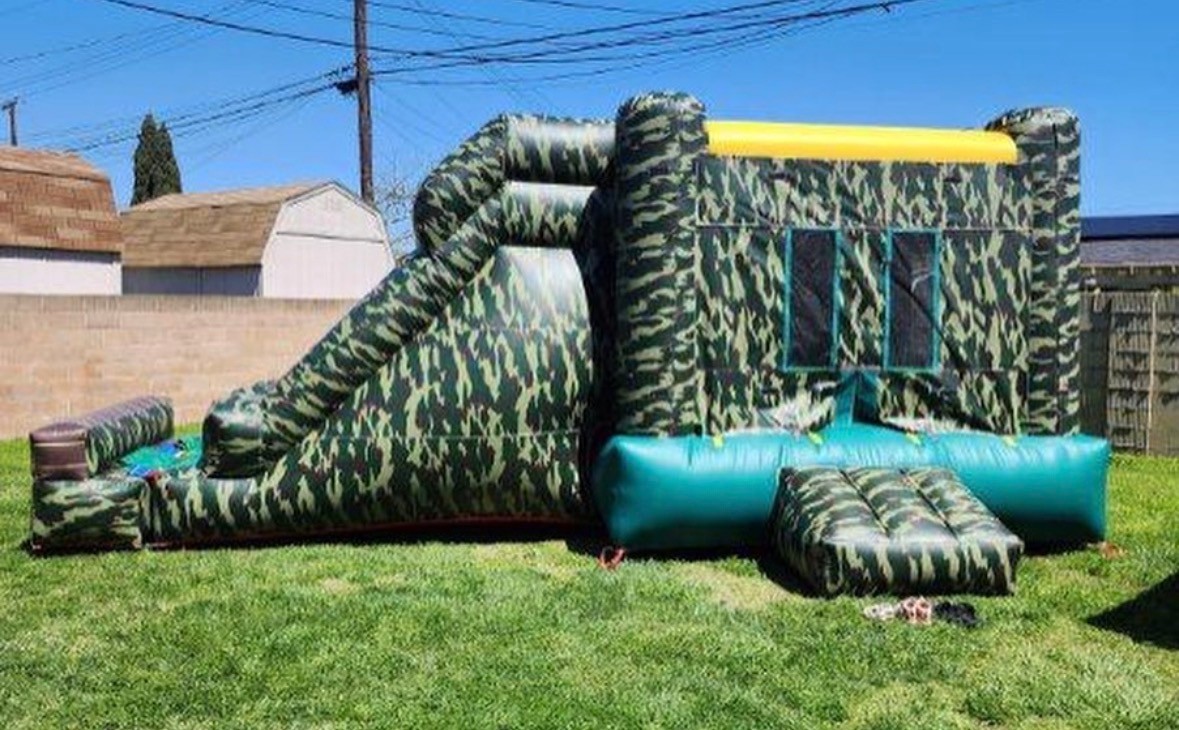
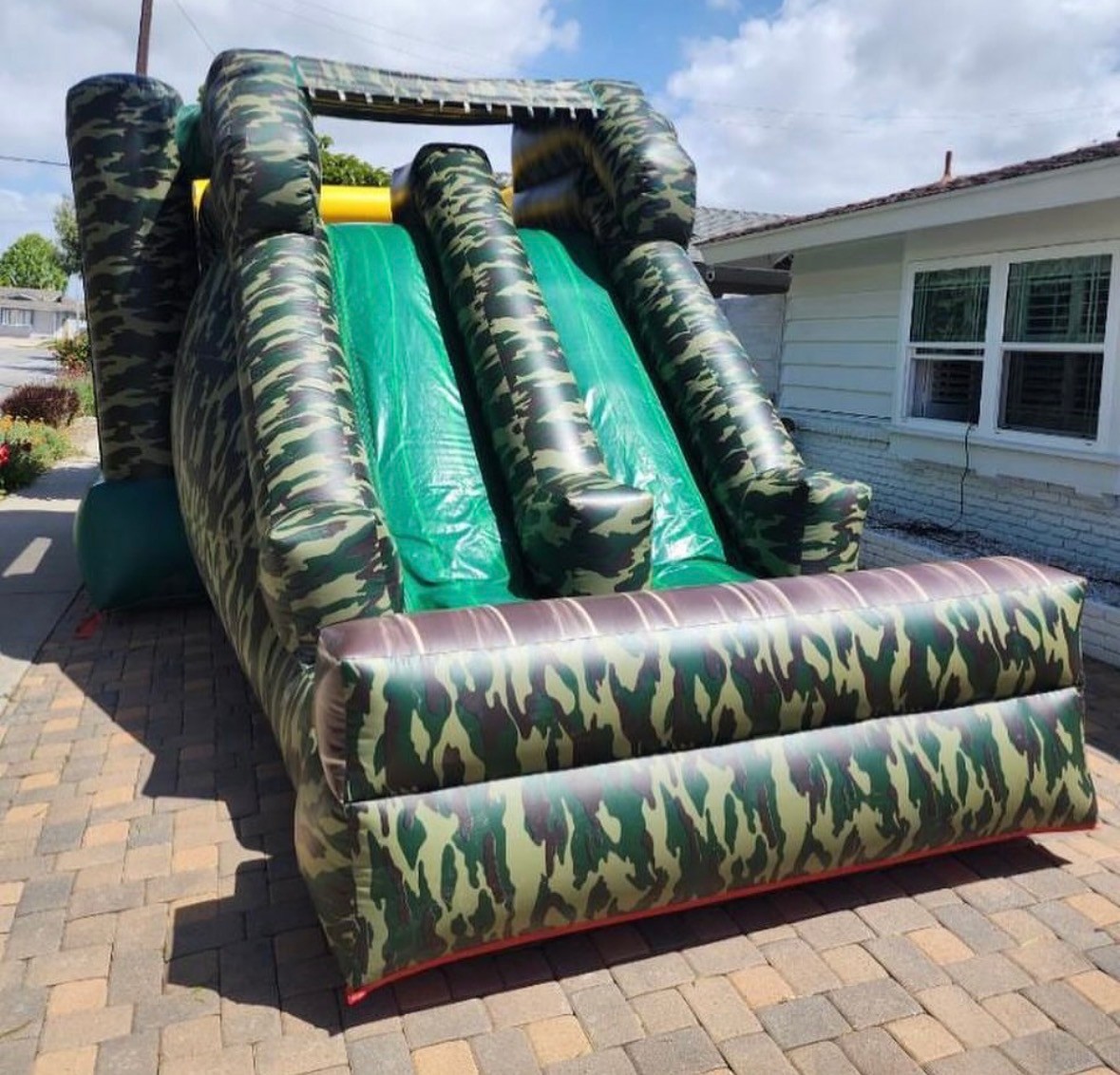
Combo units and slides. Combo inflatables that include a bounce area plus a slide or climbing wall are longer than they are wide, often running 15 to 20 feet or more in one direction. They need a rectangular open area and enough overhead clearance for the slide tower. These are better suited to larger backyards or community spaces like HOA parks and school fields.
If your open lawn area is on the smaller side, a compact unit placed thoughtfully will always be a better experience than a larger unit that barely fits and leaves no room for kids to line up safely.
How to Measure Your Backyard for an Inflatable Rental
Measuring your yard takes about five minutes and removes almost all of the guesswork from the booking process. Here is how to do it well.
Start by walking your backyard and mentally clearing out everything that would need to move or that cannot move. Patio furniture, planters, portable fire pits, and kids' toys can be relocated. Permanent structures, trees, and pool equipment cannot.
Once you have identified the open area, use a tape measure to find the longest clear length and the widest clear width. Write both numbers down. Then note the following:
Gate width. Measure the narrowest point of your side gate or the path the delivery crew would use to bring equipment into the backyard. Most inflatables arrive deflated and rolled, but the blower and anchoring equipment also need to pass through. A gate width of at least 36 inches is helpful, and wider is better.
Overhead clearance. If any part of the open area passes under a patio cover, pergola, or low-hanging tree branches, measure the height at the lowest point. Standard bounce houses typically need at least 14 to 16 feet of overhead clearance, and taller combo units need more.
Surface type. Note whether the area is grass, artificial turf, concrete, or compacted dirt. This affects how the unit gets anchored and whether any additional setup steps are needed.
Slope. Walk the area and check whether the ground is level. A gentle slope may be workable depending on the unit, but a steep grade reduces your options significantly.
Once you have these numbers, you are ready to have a productive conversation with your rental company. You will be able to confirm fit before anything is booked, which saves everyone time on delivery day.
When to Consider a Combo Unit or Obstacle Course Instead
Sometimes a standard bounce house is not the right fit, and that is perfectly fine. If your backyard is larger than average or you are hosting at a park, school, or HOA common area, a combo unit or inflatable obstacle course can add a lot more entertainment value for older kids and bigger groups.
Combo bounce houses pair a jumping area with a slide, climbing wall, or basketball hoop inside the unit. They are longer than a standard bounce house and need more rectangular open space, but they keep kids engaged longer and work well when your guest list includes a range of ages.
Inflatable obstacle courses are designed for competitive fun and are popular at school carnivals, church events, and community block parties. They typically run 30 to 50 feet in length and need a wide, open, flat surface. A residential backyard is rarely the right venue for a full obstacle course, but a large side yard, a cul-de-sac setup, or a community park can work well.
If you are unsure whether your space can handle a combo or course unit, sharing your measurements with the rental team is the fastest way to get a clear answer.
Booking the Right Size with Jump High Rentals
Jump High Rentals serves families and event organizers across Orange County, and helping customers find the right unit for their specific space is part of what the team does every day. Before you finalize a booking, reach out with your yard measurements, gate width, surface type, and any overhead clearance concerns. The team can match your open area to the right unit and flag anything that might cause a problem on delivery day.
Getting the size right before you book means no surprises when the crew arrives, a safer setup for the kids, and a party that runs smoothly from start to finish. Whether you have a compact backyard in Tustin or a larger open yard in San Clemente, there is a unit that fits your space and your guest list.
Contact Jump High Rentals with your measurements and let the team take the guesswork out of your summer 2026 party planning.