
How Much Space Does an Obstacle Course Inflatable Actually Need?
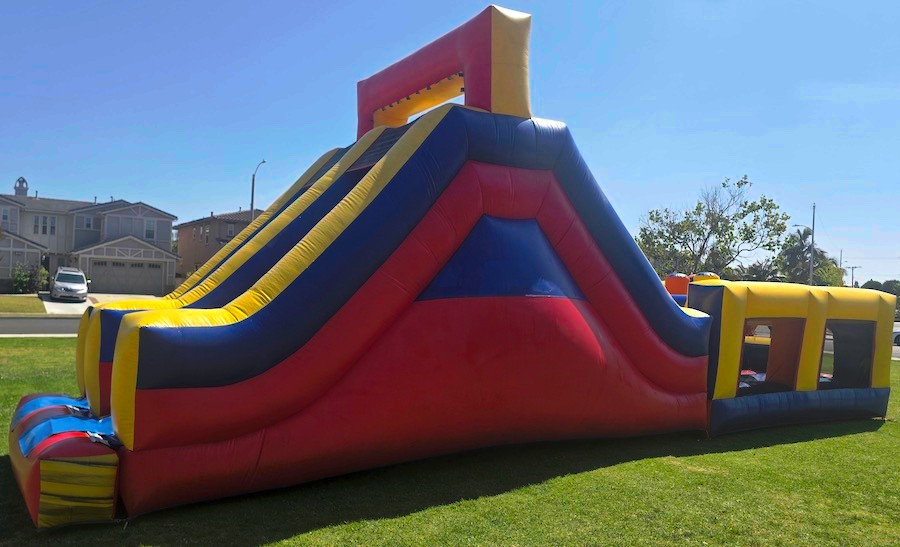
If you've been eyeing an obstacle course rental for your next backyard party in Orange County, the first question most parents ask is a simple one: will it actually fit? It's a fair concern, and the good news is that most standard OC backyards can accommodate at least one inflatable obstacle course if you measure correctly and know what to look for before you book.
Most inflatable obstacle courses fall into two general size categories. Shorter courses designed for younger kids typically run around 20 to 30 feet long and 10 to 12 feet wide, with a height of roughly 10 to 12 feet at the tallest point. Longer competition-style courses built for older kids and teens can stretch anywhere from 40 to 60 feet in length, with similar widths and heights. Those dimensions describe the inflatable itself, but the space your yard actually needs to give up is a bit larger once you factor in the room required around the unit.
A good working rule is to add at least 3 feet of clearance on every side of the inflatable footprint. That means a 30-foot course needs a clear run of roughly 36 feet, and a 50-foot course needs closer to 56 feet of unobstructed length. Width-wise, plan for at least 16 to 18 feet of open space for a unit that measures 10 to 12 feet across. These numbers aren't arbitrary. The clearance zone keeps kids from running into fences, patio furniture, or landscaping features when they exit the course at full speed, which is exactly what excited eight-year-olds tend to do.
Height clearance matters just as much as the footprint. Most obstacle courses peak between 10 and 14 feet tall, so you'll want to check for low-hanging tree branches, patio covers, pergolas, or overhead utility lines before booking. If your backyard has a covered patio that extends partway into the yard, measure from the edge of that cover to the back fence to get your true usable length.
Measuring Your OC Backyard the Right Way Before You Book
Grabbing a tape measure and walking your yard before you call is one of the most useful things you can do as a first-time renter. It takes about five minutes and it saves a lot of back-and-forth on delivery day. Here's how to approach it in a way that gives you accurate numbers.
Start at the widest open section of your yard, not the total lot size. Many backyards in Irvine, Anaheim Hills, and Yorba Linda have usable space that's smaller than the overall lot because of built-in features like raised garden beds, side-yard gates, spa equipment, or built-in barbecue islands. Walk the perimeter of the area you'd actually use for the inflatable and measure length and width separately.
Next, note where your access point is. Obstacle courses arrive rolled and folded, but they still need to be carried through a gate or side yard to reach the backyard. A standard residential side gate is typically 36 to 48 inches wide, which is usually enough, but if yours is narrower or blocked by a latch post, mention that when you contact Jump High. The delivery crew can often work around tight access, but knowing ahead of time prevents surprises. You can find more detail on what the delivery process looks like in the guide to what to expect on delivery day for OC inflatable rentals.
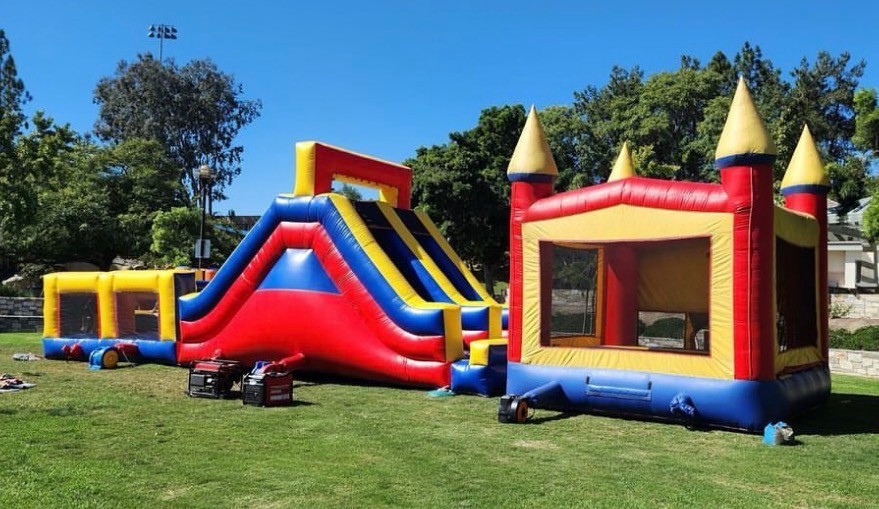
Finally, take a photo of the space from the back of the house looking toward the fence. A photo captures things measurements sometimes miss, like a tree trunk that sits right in the middle of your ideal setup zone or a slope that isn't obvious from a single vantage point. When you reach out to Jump High Rentals, sharing that photo alongside your measurements makes it much easier to recommend the right unit on the first try.
Clearance, Slope, and Surface: What Affects Setup Beyond Footprint
Square footage is only part of the picture. Three other factors shape whether a specific obstacle course will work in your yard: overhead clearance, ground slope, and surface type. Understanding each one helps you have a more productive conversation with your rental company before any deposit changes hands.
Overhead clearance is the easiest to overlook because most people measure horizontally and forget to look up. Walk the length of your intended setup zone and look for anything above 10 feet, including tree canopies, string lights, patio cover beams, or the eave of a second story. If something is in the way, you either need to move the setup zone or choose a shorter unit. Jump High can help you identify which units in the catalog stay under a specific height threshold.
Ground slope is a topic that comes up often with OC backyards, especially in hillside neighborhoods like Anaheim Hills, Coto de Caza, and parts of Laguna Hills. A gentle slope of one to two percent is generally manageable with proper staking and sandbag anchoring. Steeper grades require more evaluation. If your yard slopes noticeably from one end to the other, it's worth reading through the water slide rental setup on sloped CA backyards guide for context on how slope affects inflatable placement, and then describe your yard's grade when you book. The sloped backyard checklist is another helpful resource before you finalize anything.
Surface type affects both anchoring and the comfort of kids landing or exiting the course. Grass is the preferred surface because it allows for stake anchoring and provides a softer landing zone around the exits. Artificial turf works well too, though the anchoring method differs slightly. Concrete and pavers are usable in some cases with sandbag anchoring, but they require a conversation about the specific unit and setup zone. The concrete vs. grass setup guide covers this in more detail if your backyard is primarily hardscape.
Choosing the Right Obstacle Course Size for Your Guest Count
Once you know your available space, the next question is which size course actually makes sense for the number of kids you're expecting. Obstacle courses are designed to move kids through in sequence, so capacity works differently than it does with a bounce house where multiple kids jump at once.
For a party of 10 to 15 kids in the 5 to 10 age range, a 20 to 30-foot course is usually a great fit. Kids cycle through quickly, wait times stay short, and the footprint is manageable for a typical Irvine or Tustin backyard. If you're hosting 20 to 30 kids, a mid-size course in the 35 to 45-foot range keeps the energy moving without creating a long backup at the entrance.
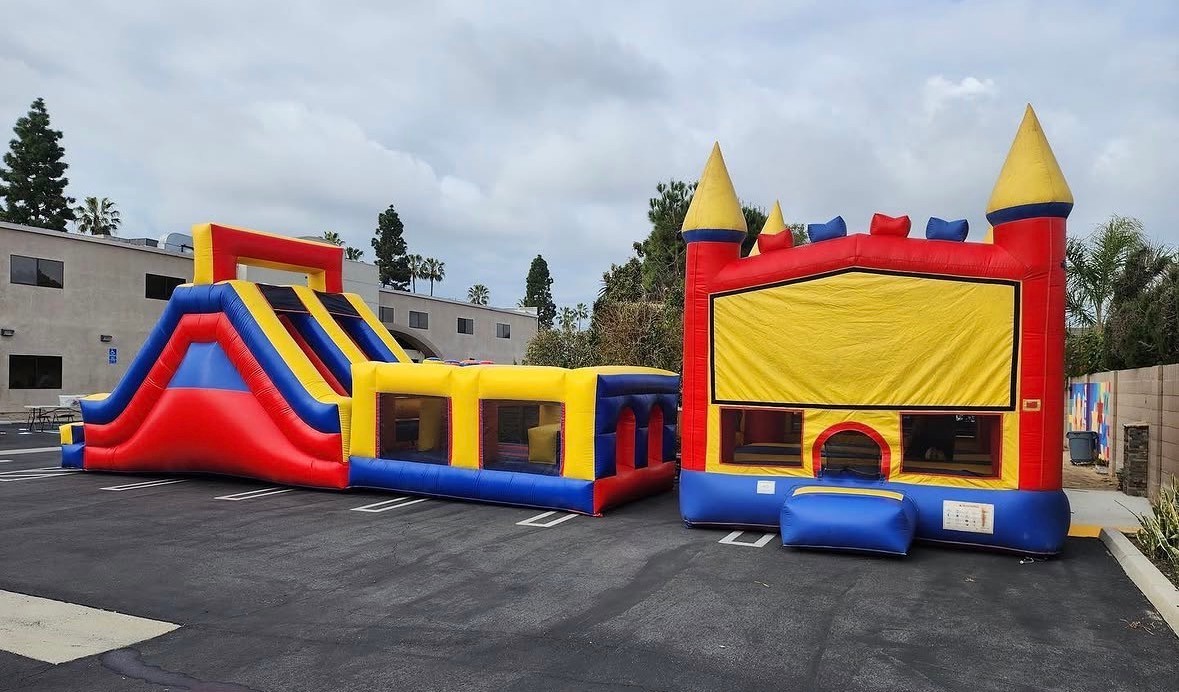
For larger gatherings, especially teen parties or school-adjacent events with 40 or more kids, a full-length 50 to 60-foot course makes more sense. These units often include multiple challenge elements like climbing walls, crawl tunnels, pop-up obstacles, and a slide exit, which keeps older kids genuinely engaged rather than breezing through in 30 seconds. If you're planning a teen event, the obstacle course rentals for teen birthdays in OC guide has more specific recommendations on unit features that hold up with older age groups.
It's also worth thinking about the mix of ages at your party. If you have a wide range, from toddlers to tweens, a shorter course with lower obstacles is safer and more inclusive than a tall competition-style unit. Pairing a shorter obstacle course with a separate bounce house or combo unit is a popular solution for mixed-age parties, and Jump High can help you figure out whether your yard has room for both.
What to Do If Your Backyard Is Too Small for a Full Course
Discovering that your yard is a few feet short of the minimum footprint doesn't have to end the conversation. There are several practical paths forward that still get you a great party setup.
The first option is to look at combo units. A combo bounce house with an attached slide and obstacle elements packs a lot of activity into a smaller footprint than a standalone course. Many combo units fit comfortably in yards that are 25 to 30 feet long, making them a realistic choice for smaller lots in denser OC neighborhoods. The combo bounce house vs. standalone slide guide walks through how these units compare if you're weighing your options.
The second option is to consider a park rental. Many Orange County parks allow inflatable rentals with the right permit, and a park setup gives you significantly more open space than most residential yards. The guide to getting a bounce house permit for an OC park event is a good starting point if that direction interests you.
The third option is simply to ask. When you contact Jump High and describe your yard dimensions honestly, the team can often suggest a unit that works within your actual space rather than the ideal one. Some obstacle courses are designed with a more compact footprint in mind, and knowing your constraints upfront means you get a recommendation that actually works on the day of your party, not a unit that arrives and can't be set up.
Browsing the Jump High rentals catalog is a helpful first step to see what's available and get a sense of the size range. From there, reaching out through the contact page with your measurements takes the guesswork out of the booking process entirely. There's no pressure to commit before you're confident the unit fits, and that's exactly how a good rental experience should start.
SEO Metadata