
Planning a backyard birthday in Orange County is exciting, and a bounce house is one of the fastest ways to make kids light up the moment they arrive. But before you confirm your rental, there is one question that trips up a lot of first-time renters: how much space do you actually need?
The short answer is more than you might think. Most families look at the inflatable dimensions listed online, measure a rough patch of grass, and assume everything will work out. In reality, the printed size of the inflatable is only one part of the equation. This guide walks you through the three measurements that actually matter, how different inflatable types change your space needs, and what to check before booking a bounce house setup in Orange County.
Why the Inflatable Size Is Only Part of the Picture
When you browse bounce house rentals, you will usually see dimensions like 15x15 feet or 18x18 feet. Those numbers describe the inflatable itself, not the total area you need to clear in your yard.
Once the unit is on the ground and fully inflated, you also need room for several things that are easy to overlook:
- The blower unit, which sits outside the inflatable and needs a few feet of clearance
- Anchor stakes or sandbags placed around the perimeter
- A safety buffer on all sides so kids can enter and exit without bumping into fences, furniture, or other guests
- Extension cords running from the nearest power outlet to the blower
Manufacturers and rental professionals commonly recommend six to eight feet of clear space on every side of the inflatable. That means a standard 15x15-foot bounce house realistically needs a cleared area closer to 20x20 feet, sometimes more depending on the specific model and your yard layout.
There is also overhead clearance to consider. Most standard bounce houses need roughly 15 to 20 feet of vertical space to inflate safely. Low-hanging tree branches, patio covers, and overhead wires can all create problems if you have not measured up before the delivery crew arrives.
Ground Space, Height Clearance, and Delivery Access Explained
There are three measurements worth taking before you contact a rental company. Getting these right before you book saves everyone time on the day of the party.
Ground footprint. Walk your yard and identify the largest flat, level area available. Bounce houses should never be placed on slopes or uneven ground because that creates a real safety hazard for the kids inside. Once you find your flat zone, measure the length and width and subtract a few feet on each side to account for the safety buffer described above. That number is your usable footprint.
Height clearance. Stand in the center of your intended setup area and look up. Check for tree branches, eaves, pergola beams, string lights, or anything else hanging overhead. A good rule of thumb is to confirm you have at least 15 to 20 feet of clear vertical space. If you are unsure, a photo taken from the side of the yard can help your rental company assess the situation quickly.
Delivery and setup access. This one surprises a lot of families. The inflatable arrives rolled or folded on a dolly, and the crew needs a clear path from the street or driveway to the setup area. A standard side gate needs to be at least four feet wide, and ideally wider for larger units. If your gate is narrow, let the rental company know in advance so they can plan accordingly. Long, narrow side yards with multiple turns can also slow down setup, so it is worth describing the path when you book.
How Different Inflatable Types Change Your Space Needs
Not all inflatables have the same footprint, and the type of unit you choose has a big impact on how much space you need to set aside.
Standard bounce houses in the 13x13 to 15x15-foot range are the most common choice for residential backyards. With the recommended safety buffer, plan for a cleared area of roughly 20x20 feet. These units also tend to have more manageable height requirements, making them a practical fit for yards with moderate overhead clearance.
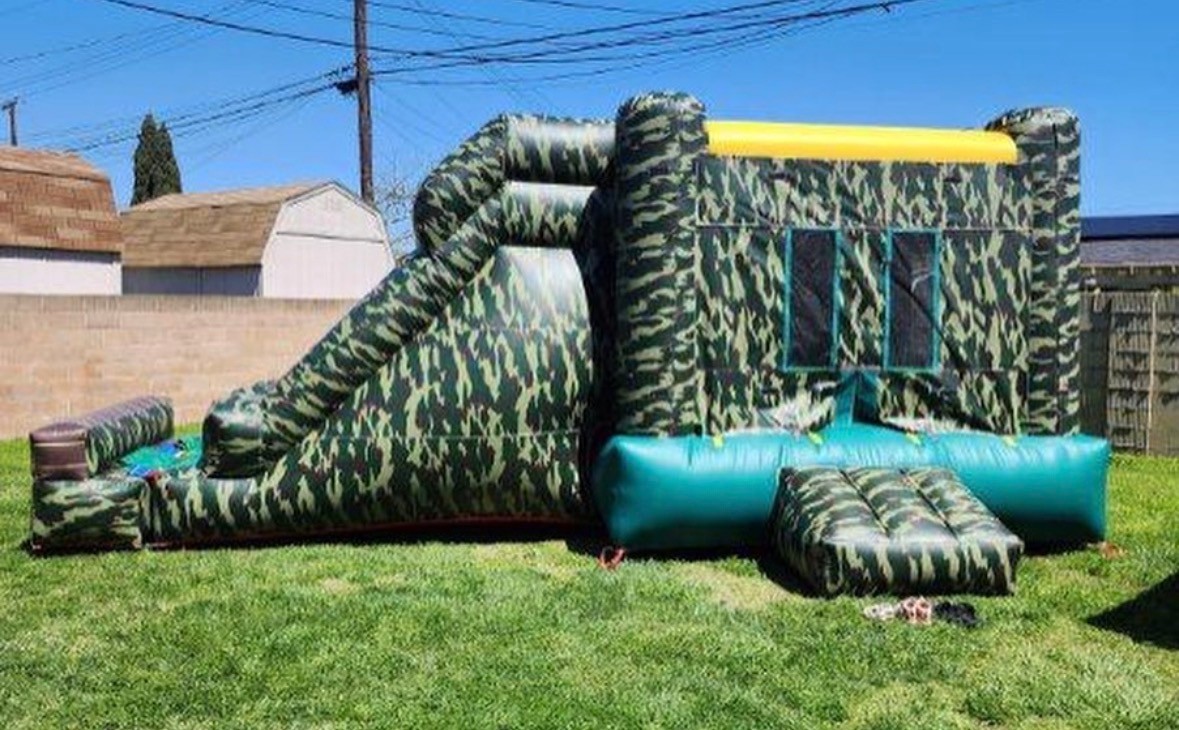
Combo units combine a bounce area with a slide, climbing wall, or basketball hoop. These are popular for mixed-age groups, but they are longer than a standard bounce house. A combo unit might measure 15x20 feet or larger, which means your cleared ground area needs to grow accordingly.
Obstacle courses are a favorite for school events, church carnivals, and HOA block parties. These units can run 30 to 50 feet in length, and some models require a total footprint of 40x40 feet or more. They are generally better suited to open fields, school grounds, or large community spaces than to a typical residential backyard.
Water slides add a length and height dimension that requires extra planning. Many water slides are taller than standard bounce houses, so overhead clearance becomes especially important. They also need a water source nearby and a flat surface that can handle wet conditions safely.
When you are comparing options, share your available space dimensions with your rental company first. That conversation is the fastest way to narrow down which units are actually a good match for your setup area.
Measuring Your Orange County Backyard Before You Book
A little prep work before you call goes a long way. Here is a simple process that takes about ten minutes and helps you book with confidence.
Start by clearing the area you have in mind. Move patio furniture, potted plants, and any toys or equipment out of the way so you are measuring the actual open space, not the space around your stuff.
Use a tape measure to get the length and width of your flat, cleared area. Write those numbers down. Then look up and estimate your overhead clearance. If you have a two-story home nearby or mature trees, take a photo from the side so the height is visible in the frame.
Next, walk the delivery path from your front gate or driveway to the setup area. Measure any gate openings and note any tight corners or steps. Steps are a common issue because the dolly used to move the inflatable cannot navigate them easily.
Finally, locate your nearest outdoor power outlet and estimate the distance to your setup area. Most blowers run on standard household current, but if the outlet is more than 50 to 75 feet away, let the rental company know so they can bring an appropriate extension cord.
Once you have those four pieces of information (ground dimensions, height clearance, delivery path, and power access), you are ready to have a productive conversation with your rental company about which units fit your space.
Tips for Parks, Schools, and Community Venues in CA
Backyard setups are the most common, but many families and event organizers in Orange County also rent inflatables for parks, school fields, church grounds, and HOA common areas. These venues come with their own set of considerations.
Public parks in Orange County often require a permit before you can set up an inflatable. Permit requirements, fees, and lead times vary by city and park location, so it is worth contacting your local parks department well in advance of your event date. Some parks also have rules about staking into the ground, which affects how the inflatable is anchored. Rental companies experienced with Orange County venues can often advise on what to expect, though the permit process itself is something you will need to handle directly with the city.
Schools and churches typically have large open fields that can accommodate bigger units like obstacle courses and combo bouncers. The main things to confirm are surface type (grass versus asphalt versus concrete), access for the delivery vehicle, and whether there are any overhead obstructions like basketball hoops, bleacher covers, or lighting structures.
HOA events in community parks or cul-de-sacs often require approval from the association before outside vendors can set up. If you are organizing a community event, check with your HOA board early and ask whether they have any vendor or insurance documentation requirements. Your rental company can typically provide the paperwork they need.
Regardless of venue, the same three measurements apply: ground footprint, height clearance, and delivery access. The more detail you can share with your rental company upfront, the smoother the setup day will go.
Ready to Find the Right Fit for Your Space?
If you are planning a party in Orange County and want to make sure you book the right inflatable for your yard or venue, the team at Jump High Rentals is happy to help. Share your available space dimensions or send a few photos, and we can recommend the unit that fits your setup, your guest count, and your event. Reach out before your date fills up, especially during the busy spring and summer season.